
A2A Payments
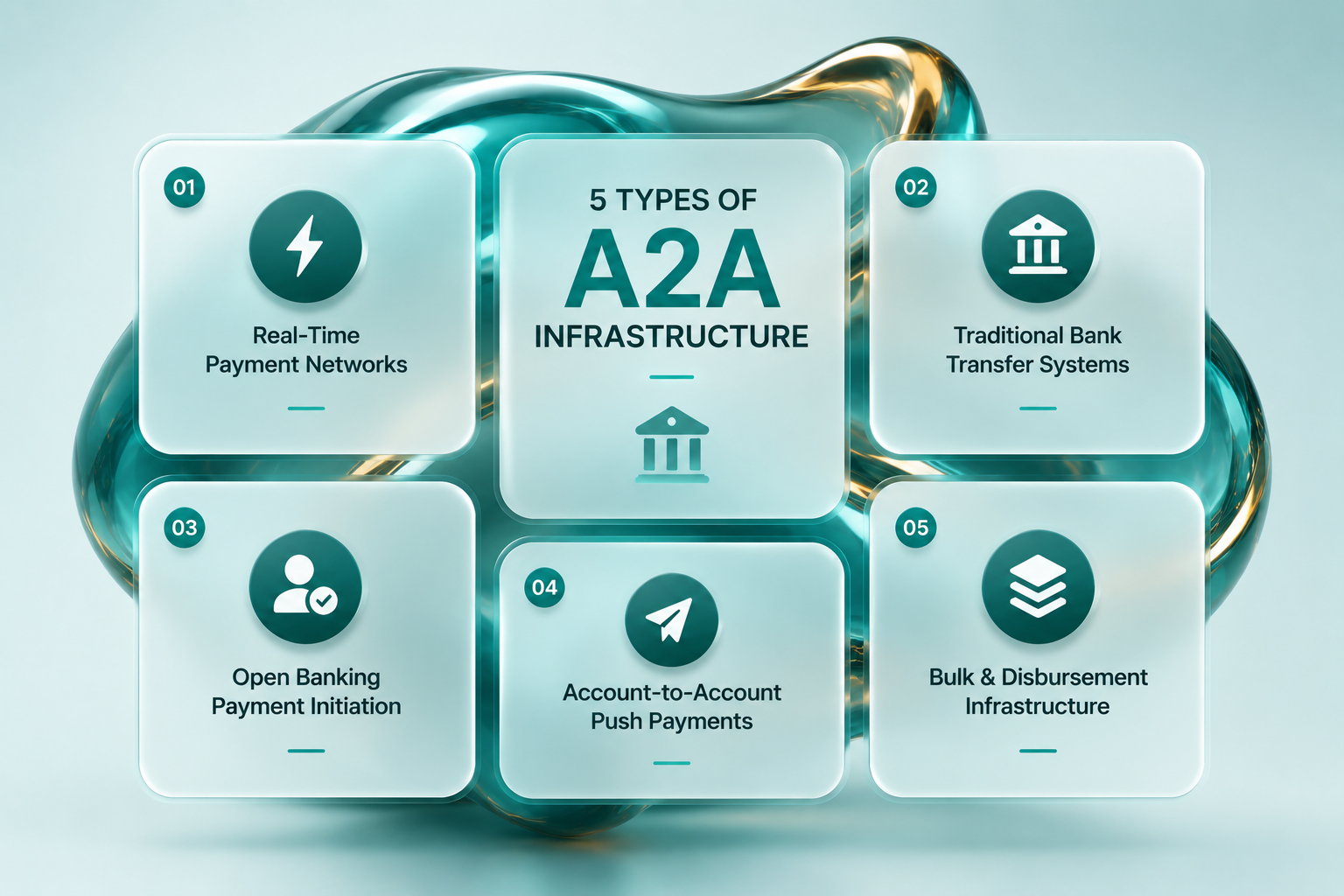
Account-to-Account Payments: The Five Infrastructure Types and Where Each One Wins
Why A2A has stopped being an "alternative" to cards and started being the default rail in many markets, and how the five distinct types of A2A infrastructure underneath actually work.
For a long time, account-to-account payments lived in the shadows of card-based commerce, technically possible, occasionally used, but rarely treated as a strategic part of a merchant's payment stack. That posture has aged badly. In multiple major markets, A2A is now the primary way customers and businesses move money digitally, with card payments increasingly the secondary option rather than the default.
The shift didn't happen all at once. It happened as instant payment infrastructure matured in market after market, Faster Payments in the UK, SEPA Instant across the eurozone, Pix in Brazil, UPI in India, FedNow in the US, each redrawing the local economics of moving money. The combined result is that for any business operating across modern markets, A2A is no longer an optional consideration.
This article walks through what A2A payments actually are, why they're winning where they're winning, and the five distinct types of A2A infrastructure underneath, each with its own settlement profile, regulatory framework, and best-fit use cases.
What A2A Payments Actually Are
An A2A payment is a direct transfer between two bank accounts, bypassing the card networks and processing intermediaries that sit in the middle of traditional card transactions. Money moves from the customer's bank to the merchant's bank using banking infrastructure directly, no Visa or Mastercard rails, no acquirer in the conventional sense, no interchange fees flowing through the middle.
The mechanism sounds simple. The implications for merchant economics are not. Without the card networks in the middle, the fee structure of a transaction looks very different. The fraud profile looks different. The settlement timing looks different. And the consumer-experience model, typically authentication inside the customer's own banking app, is structurally distinct from the card flow.
Why A2A Has Moved Into the Mainstream
The reasons A2A is winning where it's winning come down to four concrete operational advantages:
Materially lower transaction costs. Interchange fees, scheme fees, and the layered margin that comes with card processing largely disappear. For higher-value transactions in particular, the savings are substantial enough to change unit economics.
Real-time fund availability. Instant payment networks settle transfers in seconds rather than the multi-day cycles that still characterise much of card settlement. For businesses where cash flow timing matters, and that's most of them, this is real money, not a marginal improvement.
Effective chargeback elimination. Direct bank transfers don't carry the dispute infrastructure that card networks layer on top of every transaction. The legal mechanism for reversing a bank-initiated payment is structurally different, and structurally rarer, than a card chargeback.
Bank-level authentication. A2A payments are authenticated inside the customer's own bank app, typically with biometric or strong factor authentication. Stolen card credentials, the most common vector for online card fraud, simply don't apply. The fraud profile is fundamentally different.
The combination is what makes A2A attractive enough that merchants in mature markets are increasingly designing their checkout around it rather than as a side option.
The Five Types of A2A Infrastructure
What gets called "A2A" in casual conversation actually covers several distinct technical infrastructures, each with different settlement rules, geographic coverage, and best-fit use cases. Treating them as interchangeable is one of the most common mistakes merchants make when designing for A2A.
1. Real-Time Payment Networks
These are the instant payment rails that have transformed how money moves in their respective markets. Examples include Faster Payments in the UK, SEPA Instant across the eurozone, Pix in Brazil, UPI in India, FedNow in the US, and PayNow in Singapore.
The defining characteristics:
- Settlement happens in seconds, 24/7
- API-driven messages, typically in ISO 20022 format
- Instant confirmation, usually delivered via webhooks
- Funds become irrevocable almost immediately
The speed and finality make them well-suited to payroll, urgent supplier payments, instant refunds, and any commerce flow where waiting on traditional settlement creates friction or cost.
The trade-offs are mostly regional. Faster Payments has a single-transfer cap, currently in the high six figures of pounds. SEPA Instant only covers euro-denominated accounts within the scheme. Pix is essentially Brazil-only. Each network is excellent in its own geography and irrelevant outside it, which means truly global merchants need to think about coverage country by country rather than treating "real-time A2A" as one thing.
2. Traditional Bank Transfer Systems
These are the older, batch-based bank transfer infrastructures that still move enormous volumes of money. SEPA credit transfers across Europe are the canonical example, reliable, well-understood, settling within one business day through batch processing cycles.
Where they shine:
- Planned payments where instant settlement isn't required
- Supplier invoices, vendor disbursements, treasury operations
- Higher-value transfers where the cost-time trade-off favours reliability and lower per-transaction cost over speed
- Recurring B2B flows where predictability matters more than real-time
International wire transfers extend this capability globally through correspondent banking networks. The cost goes up, intermediary banks each take a cut, the timing slows down, and the complexity increases, but for high-value international transfers without other infrastructure, they remain the default option.
Traditional bank transfer systems aren't glamorous, but they handle the heavy lifting of B2B and treasury flows that the consumer-facing instant rails don't cover well.
3. Open Banking-Powered Payments
Open banking turns the customer's banking app into the payment interface. The flow looks like this:
- Customer selects "Pay by Bank" or an equivalent option at checkout
- A third-party payment initiation service requests consent through secure APIs
- The customer authenticates inside their bank app, biometrics, in-app approval, or whatever their bank requires under SCA
- The payment initiation service initiates a credit transfer on the customer's behalf
The defining regulatory framework in Europe is PSD2, which mandates Strong Customer Authentication, at least two verification factors, for most transactions. This dramatically reduces the risk of unauthorised payments compared to stored card credentials.
UK merchants have adopted this flow extensively for e-commerce checkout, particularly on higher-value transactions where the FX and processing cost savings versus cards are largest. Continental Europe follows similar frameworks under PSD2, with PSD3 expected to standardise the experience further across the bloc.
For deeper coverage of how Open Banking specifically fits into modern payment stacks, see our dedicated guide on Open Banking in 2026.
4. Digital Wallet A2A Solutions
Digital wallet A2A solutions combine the familiar consumer interface of a wallet with direct bank-account connectivity underneath. The customer sees a wallet, branded, recognisable, often already on their phone, but the actual settlement moves through direct bank transfers rather than stored wallet balances or card credentials.
The architecture matters because:
- The customer experience is familiar
- Underlying settlement uses A2A infrastructure, with the cost and speed advantages that follow
- Wallet providers handle bank relationship management and regulatory compliance
- Merchant integration is a single API call to the wallet provider, rather than direct integration with each underlying bank
Settlement timing varies depending on which underlying A2A rail the wallet is using, instant where instant rails are available, slower where they aren't. The model is increasingly common as the line between "wallet" and "bank app" continues to blur.
5. Business-to-Business A2A Systems
B2B A2A operates under different operational assumptions than consumer A2A. Transaction values are higher, approval workflows are more complex, integration requirements run deeper, and audit and compliance needs are more demanding.
What B2B A2A systems typically add:
- Integration with ERP, accounting, and treasury management tools
- Multi-level approval workflows for transactions above defined thresholds
- Detailed transaction reporting designed for audit requirements
- Transaction limits that meaningfully exceed consumer-focused systems, supporting large supplier payments, payroll, and commission settlements
For businesses moving significant volumes of money outward, to suppliers, partners, contractors, or employees, purpose-built B2B A2A infrastructure is the right tool. Consumer-grade A2A flows can technically handle some of these flows, but the controls and reporting they're missing become significant as values and volumes scale.
Matching A2A Types to Use Cases
The merchants getting the most out of A2A don't pick one type and use it for everything. They match each type to the use case where its strengths actually matter:
- Real-time networks for consumer checkout, instant refunds, payroll, time-critical supplier payments
- Traditional bank transfers for scheduled payments, supplier flows, and treasury operations
- Open banking-powered payments for consumer e-commerce, particularly higher-value transactions
- Wallet A2A solutions for consumer checkout in markets where wallet adoption is high
- B2B A2A systems for any business-to-business flow involving approvals, audit, or significant value
A well-designed payment stack supports several of these in parallel, with the orchestration layer deciding which one to surface based on the transaction context, geography, and customer profile.
Where A2A Fits Inside a Real Payment Stack
A2A isn't replacing cards. It's joining cards, wallets, and local methods as one rail in a portfolio that serious merchants are increasingly running through an orchestration layer.
What that looks like in practice:
- Cards continue to handle habitual consumer purchases, recurring billing, and markets where card culture is dominant
- Local APMs handle the markets where adoption is concentrated, BLIK in Poland, MB Way in Portugal, iDEAL in the Netherlands
- A2A, in its various forms, handles higher-value transactions, account funding, B2B flows, payouts, and any market where instant payment infrastructure has matured
- Orchestration decides, transaction by transaction, which rail is the right one, based on geography, customer, value, risk, and cost
The merchants who get this right end up with payment economics that single-rail competitors can't match, lower fees on the transactions where A2A wins, faster settlement where speed matters, lower chargeback exposure, and higher conversion in the markets where customers prefer to pay this way.
The Bottom Line
A2A payments have moved from "alternative" to "default" in many markets, and the trajectory is clear. For merchants operating across borders, understanding the five distinct types of A2A infrastructure, and matching each to the right use case, is increasingly part of what separates strong payment performance from merely adequate.
The right architecture isn't about choosing between A2A and cards. It's about building a stack where each rail handles the transactions it's structurally best suited for, with the orchestration layer making the routing decisions on a per-transaction basis.
At Paylinq, we help merchants integrate A2A payments, across real-time networks, open banking flows, wallet-based A2A, and B2B systems, alongside cards, local APMs, and the rest of the payment portfolio. Through a single orchestration layer, each rail gets used where it actually wins, with unified reporting and routing across the entire stack. If you'd like to map out where A2A would pay off in your business, get in touch with our team.
This article is provided for informational and educational purposes only and does not constitute financial, legal, tax, regulatory, or compliance advice. Specific operational, payment, and treasury decisions should be made in consultation with qualified professionals familiar with your jurisdiction and business model. References to specific schemes, regulations, networks, providers, or scenarios are illustrative only and do not imply endorsement or guarantee. Transaction limits, settlement timings, and regulatory frameworks vary by jurisdiction, scheme, and time period and may change. The authors and publisher accept no liability for actions taken based on this content. Information may become outdated as payment infrastructure and regulations evolve
Simple. Fast. Reliable.
At Paylinq, we deliver a seamless experience with full transparency and effortless operations, so payments just work.
Social Handle
