
Conversion Optimization
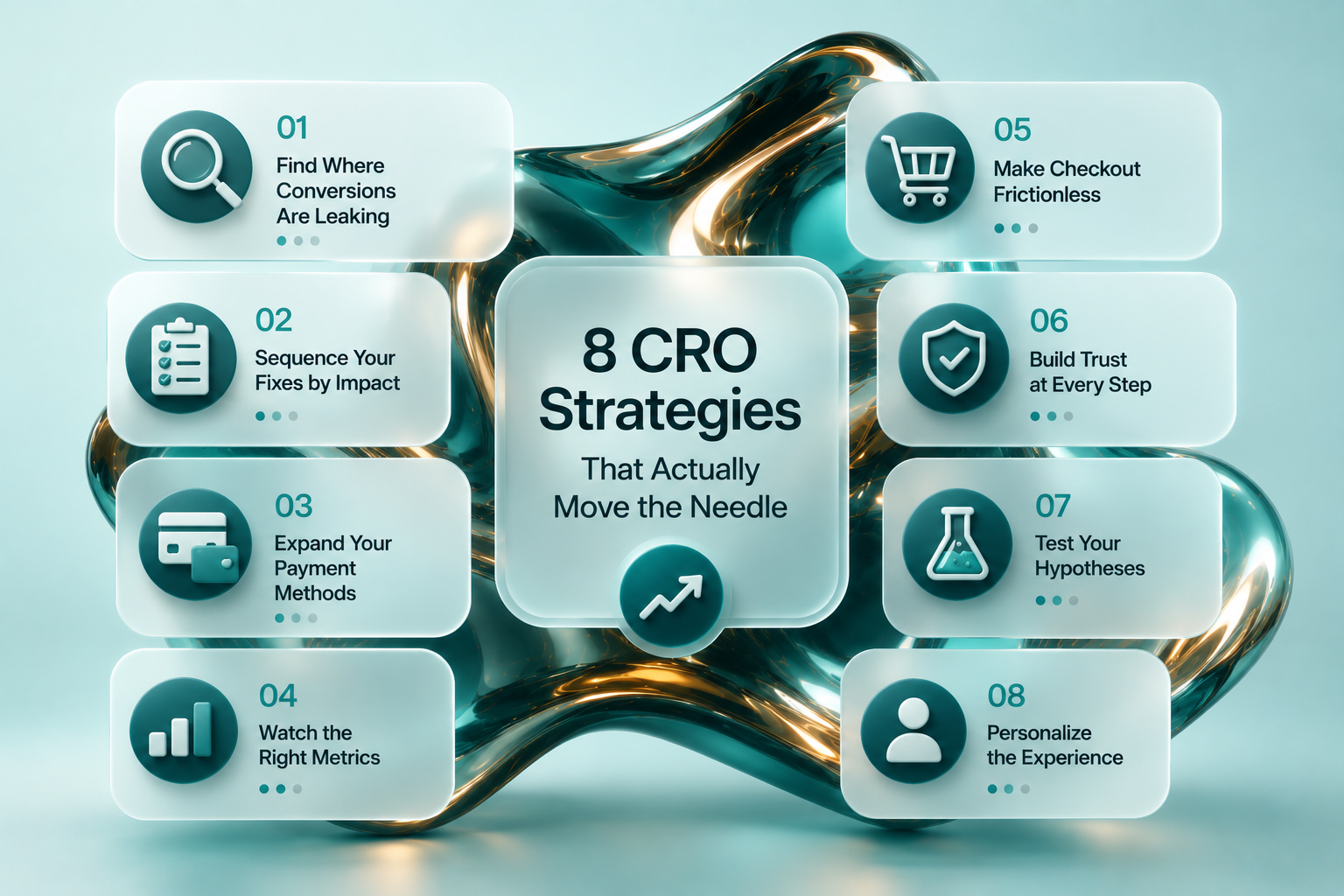
8 Conversion Rate Optimization Strategies That Actually Move the Needle
A practical CRO guide for e-commerce merchants, what to fix first, what to measure, and how to stop leaking conversions at the points most stores never look closely enough.
In e-commerce, the difference between an average store and a high-performing one is rarely a single dramatic change. It's the accumulation of small, deliberate improvements to the customer experience that quietly compound, adding up to meaningfully higher conversion rates and a healthier bottom line.
The challenge isn't motivation. Most merchants know they should be optimising. The challenge is focus: with so many possible variables to test, it's hard to know where to spend the next hour of effort. This guide cuts through that, eight CRO strategies that consistently produce results, with the underlying logic behind each one and the common mistakes to avoid.
Optimise Conversion with a Payment Layer That Works for You
Paylinq lets you build the kind of seamless checkout experience modern customers expect. Reduce friction, accept the payment methods your customers actually want, and stop losing carts at the final step.
Get started with Paylinq
What CRO Actually Is
Conversion rate optimisation is the systematic practice of improving your store's user experience to turn more visitors into customers. The work touches everything from product pages and CTAs to checkout flow and payment options, and the results show up in a single metric: the percentage of visitors who complete the action you want them to take.
Most e-commerce stores define conversion as the share of visitors who make a purchase. But "conversion" can be any goal you care about, adding to cart, signing up for a newsletter, starting a free trial. The formula stays the same: take the number of conversions in a given period, divide by total visitors in that same period, multiply by 100.
What separates serious CRO from guess-and-tweak is the systematic part. Real optimisation runs on hypotheses, measurement, and iteration, not on hunches.
Why CRO Is Worth the Effort
CRO is one of the highest-leverage activities available to an e-commerce team because it lifts revenue without requiring additional marketing spend. The visitors are already there; you're just converting more of them. The benefits extend well beyond the immediate revenue lift:
- Lifting average order value and purchase frequency from your existing customer base
- Converting new visitors who would otherwise have bounced
- Building brand trust through visible security and a polished experience
- Sharpening your understanding of who your audience actually is and what they respond to
- Producing a smoother customer journey, which feeds loyalty and repeat purchases
- Creating a feedback loop that makes every subsequent marketing investment more efficient
A merchant who improves conversion by even a small margin sees the change ripple across the entire economics of the business.
8 CRO Best Practices
1. Find Where Conversions Are Actually Leaking
Before optimising anything, identify where you're losing people. Most conversion leaks fall into one of three categories:
- Product fit issues, visitors arriving but deciding the product isn't right for them
- Experience issues, slow pages, confusing layout, limited payment options, broken flows
- Connection issues, copy that doesn't speak to the right audience, missing trust signals, weak personalisation
Talk to actual customers and ex-customers. Survey people who abandoned carts. Watch session recordings. Often the issue isn't the dramatic one you assumed. It's something simple, like shipping costs revealed too late or a payment method missing for a key market.
2. Sequence Your Fixes by Impact
Once you have a list of leaks, resist the urge to fix everything at once. The point of CRO is to learn what actually moves conversion in your specific context, which only works when you change one or two things at a time.
Start with the biggest leak you've identified. Brainstorm a few possible fixes. Pick the one most likely to work given your goals and resources. Implement. Measure. If conversion lifts, you've learned something true and can move on; if it doesn't, try another approach. Over time, this disciplined cycle compounds into a meaningfully better store.
3. Expand Your Payment Methods
Offering more ways to pay is one of the most reliable conversion levers available, and it's underused by merchants who default to "cards only." Customers complete checkout far more often when their preferred, trusted method is available, and "preferred" varies wildly by market, age group, and product category.
Paylinq makes it easy to accept cards, debit, digital wallets, account-to-account payments, BNPL, and the local methods that drive conversion in specific countries. New options can be added with a few clicks, and the dashboard shows you how each method affects conversion so you can see the impact directly.
Sign up with Paylinq
4. Watch the Right Metrics
Without good measurement, CRO turns into guesswork. The metrics that genuinely indicate where to focus:
Click-through rate (CTR). The share of people who click through to your site from a campaign or message. Low CTR points to weak creative or off-target messaging, not necessarily a site problem.
Average page depth. How many pages visitors view before leaving. High depth usually signals engagement; very high depth can sometimes signal confusion, visitors hunting for something they can't find.
Session duration. How long visitors stay on your site. Longer sessions correlate with engagement, but interpret carefully. A long session that ends without conversion may indicate hesitation rather than interest.
Bounce rate. The percentage of visitors who view one page and leave. Most e-commerce sites benchmark themselves against single-digit-percentage targets in the low-to-mid range; sustained bounce rates significantly above that suggest a mismatch between traffic source and landing experience.
Exit rate. The percentage of people who leave after viewing a specific page. This is often the most actionable metric. Start your CRO work on the pages where exit rates are highest, because that's where the impact lives.
5. Combine Quantitative Testing with Qualitative Insight
A/B testing is the workhorse of CRO. It lets you test variants of almost anything, copy, imagery, layout, CTA wording, button colours, page structure, and see which versions convert better.
Useful elements to test:
- Headline phrasing
- CTA verbs and button design
- Product description length and tone
- Page layout and information hierarchy
- Media choices, static images, video, lifestyle photography
- Trust signals and security badges
But quantitative tests only tell you what works. Qualitative research, actual conversations with customers, user testing, post-purchase surveys, abandonment surveys, tells you why. The combination is what makes CRO compound; either alone tends to plateau.
6. Build a Friction-Free Checkout
The checkout is where most lost conversion happens, and most checkout friction comes from a handful of repeat offenders:
- Form fields that aren't strictly necessary. Every additional field reduces completion. Ask for what you actually need, not what would be nice to have.
- Forced account creation. A guest checkout option captures customers who don't want to register, and most of them won't if you don't offer one.
- Surprise costs. Shipping, taxes, and fees revealed at the last step destroy trust and conversion in equal measure. Surface them earlier.
- Limited payment options. Customers reaching the final screen only to find their preferred method missing often don't return.
- A checkout that doesn't look like your site. Disjointed visual experience erodes the trust the rest of the site built.
Paylinq gives you the tooling to design checkout the way it should look and behave. Use a hosted checkout that carries your brand cleanly, or integrate the components directly into your site through the API, whichever fits your team and your customers better.
7. Make Your Site Genuinely Fast
Speed is non-negotiable. Customers click away from slow-loading pages, and the relationship between load time and conversion is consistently negative. Every additional second of delay costs measurable conversion. Aim for sub-three-second loads across desktop and mobile; beyond that, the drop-off rate climbs steeply.
Practical things that help:
- Identify and remove elements that block rendering
- Compress and properly size images; defer video and any non-essential media
- Pick a hosting setup that handles your peak traffic without degrading
- Lazy-load content that's not immediately visible
- Audit your stack regularly, sites slow down quietly as plugins, tags, and trackers accumulate
Speed isn't glamorous, but it's one of the highest-ROI investments in CRO that exists.
8. Make Your Security Visible
Customers won't pay for what they don't trust. Trust signals don't have to be loud, but they do need to be present.
Paylinq operates at Level 1 PCI DSS, the highest compliance level available, so you can display the appropriate security badges throughout checkout. We tokenise card details in transit, which means card data can't be intercepted into usable form at any point in the flow.
Beyond compliance badges, the small visible signals matter too: HTTPS without warnings, recognisable payment-method logos, clear return policies, real contact information, and visible reviews. Each one is a small reassurance that builds toward the click that becomes a purchase.
Why Paylinq Works for E-Commerce Merchants Serious About CRO
Paylinq provides a full-service payment infrastructure designed to scale with your store. The platform supports:
- Fast global payment processing, so you can convert customers across markets without rebuilding for each new one
- High-grade security with Level 1 PCI DSS compliance, tokenisation, and authentication tooling built in
- Multi-factor authentication through 3D Secure 2 to reduce fraud without adding unnecessary friction
- Detailed conversion insights through a clear dashboard that lets you see exactly how payment choices affect outcomes
- A wide range of payment methods, with new options added regularly as adoption shifts
Whether you prefer a customisable no-code checkout or want to integrate components into your existing site through the API, Paylinq is designed to be set up quickly and tuned continuously.
Create your Paylinq account
The Bottom Line
You can endlessly tweak individual elements of your store, but the merchants who get sustained CRO wins do it systematically, finding the biggest leaks first, fixing them deliberately, measuring honestly, and iterating from real evidence rather than guesswork.
The payment layer matters more in this picture than most CRO guides acknowledge. A checkout that's missing the right methods, slow to load, or visually disconnected from the rest of the site can quietly undo everything the marketing and product teams accomplished.
When you sign up with Paylinq, you get the payment infrastructure designed to support that work, from method coverage to security to conversion analytics. We're built to be a real CRO partner in the payment layer, not just a vendor moving money.
Get started with Paylinq
FAQs
What's the best way for an online business to accept payments?
Paylinq is purpose-built for online businesses serious about both conversion and security. We support a wide range of payment methods alongside Level 1 PCI DSS compliance, tokenisation, and 3D Secure 2 authentication. The back-end complexity sits with us so you can focus on growing the business.
Create your Paylinq account
What's an ideal e-commerce conversion rate?
Strong e-commerce stores typically operate in the 3-4% range, with the cross-industry average sitting somewhere closer to 2.5-3.5%. Aiming above the average usually positions a store well within a competitive market. The right target for your business depends heavily on your specific niche and audience.
What's a realistic conversion rate to aim for?
A realistic baseline for most e-commerce categories sits in the 2-3% range. The overall industry average runs slightly higher, around 3% give or take. But niche matters significantly, categories like arts and crafts often see conversion in the higher single digits, while categories like agriculture, baby products, and food and beverage often run noticeably lower. Benchmarking against your specific category is far more useful than chasing a generic number.
Is conversion rate a useful KPI?
Conversion rate is one of the most important KPIs an e-commerce business can track. It directly reflects how well your marketing, product, and site experience are working together. A consistently high rate signals strong alignment across these layers; a flat or declining one signals that something specific needs investigation. Regular CRO work is how strong e-commerce teams stay ahead of that drift.
This article is provided for informational and educational purposes only and does not constitute financial, legal, tax, regulatory, or compliance advice. Specific operational, payment, and commercial decisions should be made in consultation with qualified professionals familiar with your jurisdiction and business model. References to specific providers, methods, schemes, or scenarios are illustrative only and do not imply endorsement or guarantee. Benchmark figures and industry averages cited are illustrative and vary by category, geography, and time period. The authors and publisher accept no liability for actions taken based on this content. Information may become outdated as e-commerce conditions evolve.
Simple. Fast. Reliable.
At Paylinq, we deliver a seamless experience with full transparency and effortless operations, so payments just work.
Social Handle
