
Smart Routing
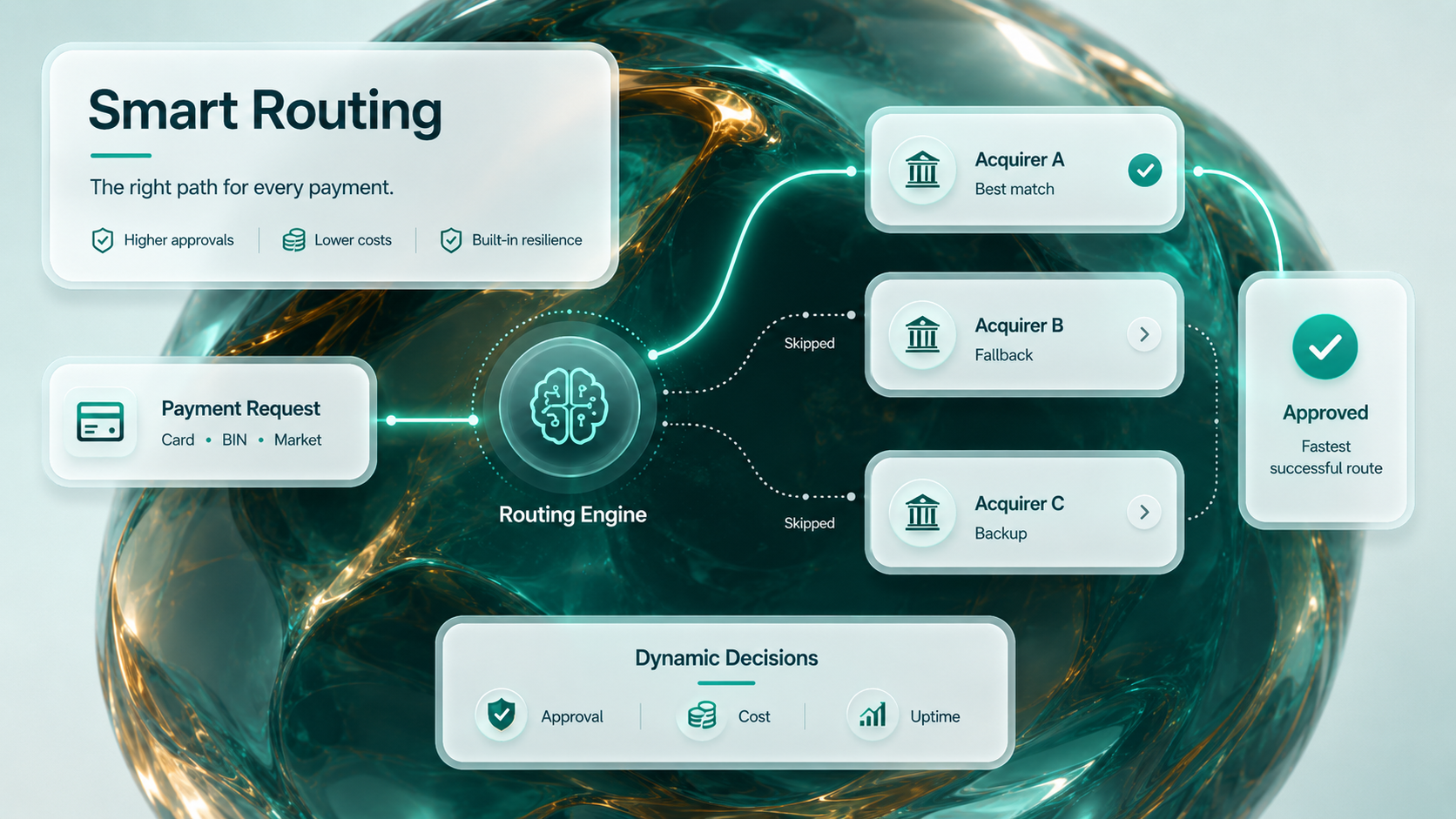
Smart Routing: What Actually Happens After "Pay Now" and Why It Matters More Than Most Merchants Realise
The decision tree behind every transaction, why single-processor stacks leak revenue, and how dynamic routing turns checkout into a competitive advantage rather than a coin flip.
From the customer's side, an online payment looks like a single moment. Tap the card, click the button, see the confirmation. Done.
From inside the payment stack, that single moment is the start of a decision tree that runs in milliseconds and quietly determines whether the merchant gets paid. Multiple acquirers, multiple networks, multiple banks, dozens of small variables, and a routing layer that either makes the right choice for that specific transaction or doesn't.
For most merchants, this layer is invisible until something starts going wrong: approval rates drift down without an obvious cause, fees creep up, a single processor has a bad afternoon and revenue evaporates with it. By the time the symptoms show up in the dashboard, the underlying problem - that every transaction is being sent through one path regardless of whether that's the right path - has been costing money for months.
Smart routing is what fixes that. Instead of sending every payment through a single fixed processor, a smart routing layer evaluates each transaction in real time and chooses the path most likely to approve it, at the lowest cost, with the most reliable provider for that specific case. The merchant sees higher approval rates, lower fees, and a checkout that holds up under conditions where simpler setups quietly fall apart.
This article walks through what smart routing actually does, when it stops being optional, and how the strongest payment stacks use it.
What Smart Routing Actually Is
Smart routing - sometimes called intelligent transaction routing or dynamic routing - is the logic that decides, transaction by transaction, which acquirer or processor a payment should be sent to. It sits between the merchant's checkout and the payment networks underneath, evaluating each transaction against live data before committing to a path.
The key shift it represents:
- Before: every transaction takes the same route, regardless of card, country, or context
- After: every transaction is evaluated individually and routed to the path most likely to succeed
Think of it less like a single road and more like a routing engine in a delivery network. Every package looks similar from the outside, but the right path depends on origin, destination, weight, time of day, and the current state of the network. Smart routing brings that same logic into payments.
What's Actually Happening in Those Milliseconds
When a customer clicks pay, the routing layer takes in a surprising amount of context before deciding what to do:
- Card data: brand, card type, BIN, country of issuance
- Customer data: location, currency, device, basket size
- Merchant configuration: business rules, preferred acquirer hierarchies, cost ceilings
- Live processor state: current approval rates, latency, error rates, uptime
- Historical performance: how each acquirer has performed for this BIN, this market, this card type, recently
The engine weighs all of that and chooses the route most likely to result in a clean approval at acceptable cost. If that primary route declines for a recoverable reason, failover routing instantly retries against a secondary processor, often recovering a sale that a single-processor setup would have logged as lost.
All of it happens behind the screen. The customer sees a smooth checkout. The merchant sees an approval. The complexity stays where it belongs: under the hood.
Why Single-Processor Setups Quietly Bleed Revenue
The simplest payment stacks send every transaction through one acquirer, every time. That works until the limits of the model start showing up:
- Performance varies by issuer. Acquirer A may approve 95% of transactions on a particular UK BIN; Acquirer B may approve 87%. Sending every transaction to one of them, regardless of card, leaves money on the table.
- Performance varies by region. A processor that handles UK transactions beautifully may underperform on Polish or Brazilian cards. A single-processor setup absorbs the difference as lost approvals.
- Processors have bad days. Latency spikes, brief outages, and rule changes happen. With no alternative path, every minute of degraded performance shows up as failed transactions.
- Costs aren't uniform. The cheapest acquirer for one card type isn't the cheapest for another. Static routing pays the average rather than optimising the mix.
- Cross-border surcharges add up. International cards routed through the wrong acquirer attract fees that local acquiring would avoid entirely.
Each of these is small in isolation. Together, on volume, they routinely cost merchants several percentage points of approval rate and a meaningful share of margin, without ever showing up as a single, identifiable failure.
How Different Industries Actually Use It
The core principle is the same everywhere, but the specific ways smart routing pays off shift by vertical:
E-commerce. During flash sales, seasonal peaks, and campaign-driven traffic spikes, smart routing redistributes load across multiple processors instead of concentrating it on one. Approval rates hold up under pressure rather than degrading exactly when volume is highest.
Travel and ticketing. Cross-border transactions and multi-currency bookings make routing decisions especially valuable. Routing to a local acquirer rather than processing internationally can simultaneously raise approval rates and reduce FX-related fees.
Subscriptions and recurring billing. Failed renewals are silent churn. Smart routing combined with intelligent retry logic recovers a meaningful share of failed renewal attempts, with each recovered renewal often worth far more than its transaction value.
iGaming and high-risk verticals. Approval rates are structurally lower in these sectors, and the gap between processors is larger. Routing each deposit to the acquirer most likely to approve it - by BIN, market, and risk profile - directly affects deposit success rates and player engagement.
Marketplaces and platforms. Multi-currency, multi-region flows benefit disproportionately from local acquiring in each market, which routing logic can switch between automatically based on customer geography.
In every case, the value isn't generic "more approvals" - it's targeted recovery of the specific transactions a static setup was leaking.
What Smart Routing Actually Delivers
Strip away the marketing language and the concrete benefits land in a few specific places:
Higher approval rates. Each transaction goes to the path most likely to approve it. Aggregated across volume, this typically translates into several percentage points of lift, and that lift falls straight to the bottom line.
Lower processing costs. Routing optimises across a mix of acquirers rather than paying a single rate for everything. Cross-border surcharges shrink when traffic is routed locally where possible.
Resilience. Processor outages stop being existential events. Traffic shifts automatically to alternative paths and the merchant continues to operate while everyone else is filing tickets.
Stronger international economics. Local acquiring in target markets means lower fees, higher approval rates, and customer-facing payment experiences that feel native rather than foreign.
A measurably better customer experience. Fewer false declines, faster checkouts, fewer abandoned carts, and a smaller fraction of legitimate customers who silently churn after a bad payment experience.
When Smart Routing Stops Being Optional
Plenty of small, single-market merchants run perfectly well on a single processor. The point at which smart routing transitions from "nice to have" to "required" tends to coincide with a few specific conditions:
- You operate in more than one country or currency
- You're seeing decline rates that don't match your apparent risk profile
- You depend on a single processor and have no fallback if they have a bad day
- You handle subscription billing or other recurring flows where renewal failures compound into churn
- You experience meaningful traffic spikes during seasonal or campaign-driven peaks
- You sit in a high-risk vertical where every percentage point of approval rate is hard-fought
Hit any two or three of these and a single-processor stack has likely become the binding constraint on revenue, even if the leak isn't yet showing up clearly in the metrics.
Smart Routing vs Traditional Payment Processing
The structural difference is straightforward:
CapabilityTraditional Single-Processor SetupSmart Routing LayerRouting decisionsOne static path, fixed in advancePer-transaction, evaluated in real timeResponse to processor downtimeFailed transactions until processor recoversAutomatic failover to alternative processorsApproval rate optimisationWhatever the single processor deliversTuned per BIN, market, and card typeCost optimisationSingle fee schedule applied to everythingCost-aware routing across multiple acquirersInternational supportOften forces cross-border processingRoutes to local acquirers where availableResilience profileSingle point of failureDistributed, redundant by design
The contrast is between a payment system that takes whatever it gets and one that actively negotiates better outcomes for every transaction.
Advanced Routing Strategies That Move the Needle
Once basic smart routing is in place, the real performance gains come from layering more sophisticated logic on top:
BIN-level routing. The first six digits of a card identify the issuing bank. Different acquirers have different relationships with different issuers, and approval rates can vary significantly by BIN. Routing decisions made at this level often outperform broader rules.
Time-of-day routing. Some processors perform better in specific hours due to issuer behaviour or network conditions. Routing logic that's aware of these patterns picks them up automatically.
Risk-tiered routing. Low-risk transactions routed through the cheapest acceptable acquirer; medium-risk through ones with stronger fraud controls; high-risk through specialists or step-up authentication. The risk score itself becomes a routing signal.
Intelligent retry logic. A failed transaction isn't always final. Retrying through a different acquirer, sometimes with different parameters, recovers a meaningful share of declines that would otherwise be logged as lost.
Cost-vs-approval balancing. Configurable rules that tune the trade-off between cheapest path and highest-approval path, depending on transaction value or merchant strategy.
These aren't tricks; they're the layered logic that separates competent routing from genuinely high-performing routing.
How to Bring Smart Routing Into Your Stack
There are essentially two paths:
Use a payment orchestration platform. A single integration connects the merchant to multiple acquirers and includes routing, retry logic, analytics, and compliance tooling out of the box. This is the route most merchants take, because it shifts the engineering effort from "build and maintain a routing engine" to "configure rules and monitor outcomes."
Build it in-house. Maximum control, maximum flexibility, and substantial ongoing engineering investment. Maintaining acquirer integrations, monitoring processor health, building retry logic, keeping compliance tooling current, and continually retuning routing rules is real work, and it doesn't get smaller as the business grows.
For most merchants outside the largest enterprises, orchestration is the cleaner path. The same engineering effort delivers more incremental value almost anywhere else in the business.
The Bottom Line
Smart routing is, in some ways, the least visible and most consequential layer in a modern payment stack. It doesn't change what customers see at checkout. It just changes whether their payment goes through, how much it costs the merchant, and how stable that experience is on the days when something underneath isn't behaving.
The merchants treating routing as an afterthought are quietly leaving approvals, margin, and resilience on the table. The ones treating it as a strategic layer are turning every "Pay Now" click into a small but real competitive advantage.
In an environment where the gap between strong and weak payment performance keeps widening, that's not a side detail. It's a meaningful piece of how growth-stage businesses outperform.
At Paylinq, we help merchants put intelligent routing at the centre of their payment infrastructure. Through a single orchestration layer, our clients connect to multiple acquirers, route dynamically across markets and BINs, recover failed transactions through retry logic, and monitor performance with the granularity needed to keep improving over time. If you'd like to map out what stronger routing would look like for your business, get in touch with our team.
This article is provided for informational and educational purposes only and does not constitute financial, legal, tax, regulatory, or compliance advice. Specific operational, payment, and routing decisions should be made in consultation with qualified professionals familiar with your jurisdiction and business model. References to specific industries, providers, or scenarios are illustrative only and do not imply endorsement or guarantee. The authors and publisher accept no liability for actions taken based on this content. Information may become outdated as payment infrastructure, regulations, and market conditions evolve.
Simple. Fast. Reliable.
At Paylinq, we deliver a seamless experience with full transparency and effortless operations, so payments just work.
Social Handle
