
Fraud Prevention
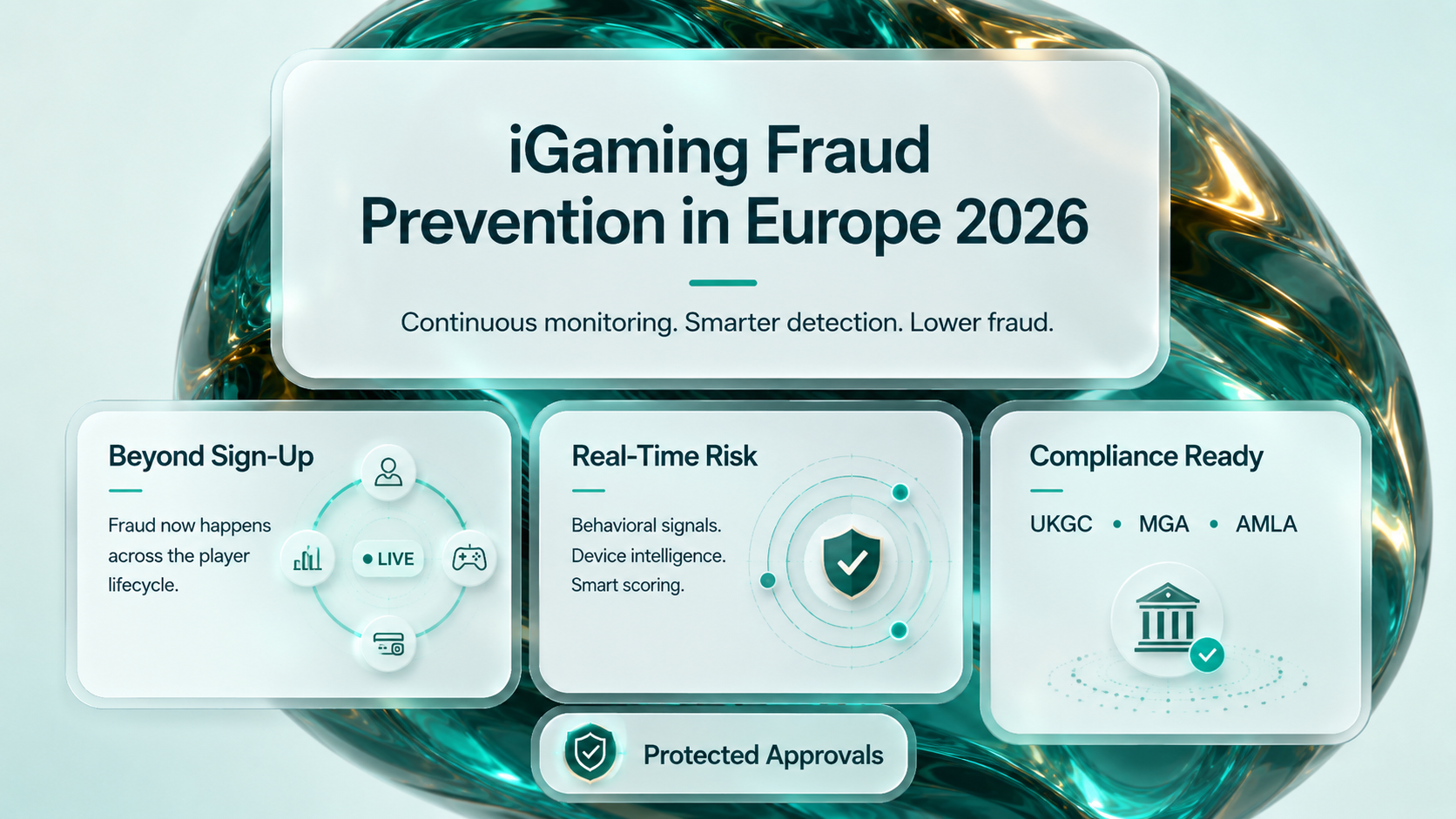
iGaming Fraud Prevention in Europe 2026: The Operator's Field Guide
Why the threat has moved past the signup screen, what UKGC, MGA, and AMLA actually expect now, and how a modern detection stack can shrink fraud losses without choking conversion.
The fraud problem in European iGaming has changed shape. A few years ago, most of the defensive thinking sat at the front door - verify the player at signup, run document checks, score the device, and you'd caught the bulk of what was coming. That model is still necessary, but it's no longer where the fight actually lives.
Today, the majority of fraud against iGaming operators happens after a player is registered, deposited, and apparently legitimate. Fraud rings are patient. AI tooling has lowered the cost of looking real. And regulators across Europe - UKGC, MGA, and the incoming EU Anti-Money Laundering Authority (AMLA) - have moved well beyond ticking boxes at onboarding. They expect continuous, risk-based monitoring across the player lifecycle.
The good news, for operators willing to invest in the right architecture, is that this is solvable. A layered stack that combines modern KYC, behavioural intelligence, real-time transaction scoring, and intelligent payment orchestration can meaningfully reduce loss rates and lift approval rates at the same time. The two goals stop competing once the underlying tooling stops being static.
This guide walks through what's actually happening in 2026, what the new rules require, and how the strongest operators are responding.
Key Takeaways
- European iGaming operators are estimated to lose several billion euros every year to fraud, with close to half of operators reporting losses above 10% of turnover and a meaningful minority reporting losses above 20%.
- Fraud has moved downstream: the large majority of incidents now occur after registration, and around two-thirds of operators rank bonus abuse as their single largest risk.
- UKGC and MGA rules - alongside the EU's incoming AMLA framework in 2026 - require pre-deposit verification, ongoing risk-based monitoring, and enhanced due diligence on crypto and other high-risk methods.
- AI-generated deepfakes and synthetic identities are climbing fast, and regulators have begun explicitly flagging them as emerging ML/TF risks.
- Operators combining behavioural analytics, device intelligence, and intelligent payment routing report measurable drops in manual reviews, lower chargeback ratios, and improved approval rates - though outcomes vary by implementation.
- The strongest performers treat fraud prevention as part of their product experience, not as an isolated risk function.
How Big the Problem Actually Is
The headline figure - losses running into several billion euros annually across European iGaming - is the kind of number that's easy to glaze over. The operator-level breakdown is where it bites:
- Roughly half of operators say fraud now eats more than 10% of turnover
- A meaningful minority - somewhere around one in seven - put the figure above 20%
- The large majority report that the problem grew year-on-year
- More than four in ten operators flag the deposit moment specifically as a vulnerable point
What's striking isn't just the scale. It's the shift in shape. The deposit phase is exposed not because onboarding is failing, but because attackers have learned that onboarding is increasingly hard to beat directly - so they get through it cleanly and play a longer game.
Layered on top of all of this is the cost of getting it wrong with regulators. UKGC fines, MGA licence reviews, and the UK's "failure to prevent fraud" corporate offence under the Economic Crime and Corporate Transparency Act mean that loss-to-fraud and loss-to-enforcement now travel together.
The Fraud Playbook in 2026
A few patterns dominate the day-to-day reality for European operators:
Bonus abuse and multi-accounting. The most common and most costly. Individuals or coordinated rings open multiple accounts, claim welcome offers, satisfy minimum wagering through low-stakes play, then withdraw. AI tooling now helps these rings mimic organic player behaviour - varying session times, bet sizes, and game choices - so static detection rules struggle to spot them.
Account takeover (ATO). Stolen credentials get reused on iGaming platforms because balances can sometimes be liquidated faster than at banks. Tell-tale signs include impossible-travel logins, abrupt device changes, and mismatches between IP, geolocation, and the registered payment instrument.
Money laundering and structured deposits. Funds get layered through deposits and withdrawals, often via crypto and other higher-risk APMs. The UKGC has called out increased focus on cryptoassets, particularly in the wake of major exchange thefts in 2025.
Synthetic identities and deepfakes. AI-generated documents and face-swap video can defeat single-frame liveness checks. Regulators have begun explicitly addressing this. Multi-frame liveness and behavioural cross-checks are quickly becoming the new floor.
Chargeback and refund abuse. "Did not receive" and "unauthorised" disputes against digital credits, sometimes coordinated, sometimes opportunistic. In some high-risk verticals, dispute handling costs alone reach around €99 per case.
The common thread: attackers prefer to blend in first and act later. That's exactly the gap a stack focused only on the front door fails to close.
What the Regulators Now Expect
The compliance picture has hardened considerably across the bloc. A working summary for 2026:
Pre-deposit verification. "Play first, verify later" is over under current UKGC rules. Identity and age must be confirmed before any deposit or play. Affordability checks apply at lower thresholds than before - typically in the €150-500/month range, depending on the implementation phase.
Ongoing AML monitoring. UK Licence Condition 12.1 makes continuous, risk-based monitoring a baseline expectation. Crypto and similar high-risk channels attract enhanced due diligence by default.
AMLA, arriving through 2026. The EU's new authority brings standardised KYB across member states. Affiliates, payment partners, and other third parties fall under stricter ownership and control verification.
PSD2 and Strong Customer Authentication. SCA is mandatory, but well-designed implementations using behavioural and biometric factors keep friction low for legitimate players.
Real-time transaction reporting. Italy's SIC system is already live, and similar regimes are spreading. Suspicious Activity Reports (SARs) need to be filed promptly, with specific attention to AI-assisted document fraud.
The blunt version: getting this wrong now risks licence suspension, six- or seven-figure fines, and corporate-level liability. Getting it right turns compliance into a barrier to entry that smaller, less-prepared competitors can't easily clear.
A Modern Detection Stack, Layer by Layer
Single-layer, rule-based detection isn't viable in this environment. The setups that actually hold up share a similar shape:
1. Identity verification with depth
Biometric facial verification, multi-frame liveness checks, document authenticity analysis, and cross-referencing against authoritative databases. The bar is now high enough that synthetic IDs and deepfakes get caught at the gate without slowing down genuine signups.
2. Behavioural and device intelligence
Real-time scoring on signals that don't lie even when documents do:
- Session rhythm
- Device fingerprints, browser entropy, and velocity across accounts
- Geolocation, IP, and payment-method coherence
- ML models trained across very large game-round corpora that surface bonus-abuse patterns rule engines simply can't spell out
3. Real-time transaction scoring
Every deposit, bet, and withdrawal scored as it happens. The output drives selective intervention - step-up authentication or manual review - only where the risk justifies it. Most legitimate transactions never see friction.
4. Payment orchestration and intelligent routing
This is where a lot of the operational leverage actually lives. A single orchestration layer connects multiple acquirers, APMs, and risk vendors. Routing logic can:
- Send higher-risk transactions to stricter processors or trigger extra authentication
- Push lower-risk traffic through faster, cheaper routes
- Reroute around degraded providers in real time
- Unify analytics across the entire flow rather than splitting them across tools
Operators running layered orchestration commonly see approval rates lift by high single digits to low double digits in percentage points, without raising fraud exposure - because the friction goes onto the small slice of traffic that warrants it, and off the large majority that doesn't.
5. Post-event controls
Automated chargeback defence, network tokenisation for stored credentials, and velocity caps on withdrawals close the loop. These tools are most powerful when they share signals with the upstream layers - the same risk score that flagged a deposit can throttle the related withdrawal.
Operating Habits That Separate the Strong Operators
Beyond tooling, the operators who measurably outperform tend to do a few things consistently:
- Score continuously, not only at onboarding. Risk profiles update as behaviour changes.
- Unify fraud and AML into a single decision view. Two scoring systems create false positives; one cuts them.
- Segment by risk tier and apply controls dynamically. Tighter bonus limits for new accounts, faster payouts for verified loyal players.
- Sandbox-test new bonuses before launch. Run fraud simulations against promo mechanics. Find the abuse path before attackers do.
- Watch the dark-web economy. Pre-loaded accounts and leaked credentials show up there before they show up on your platform. Monitoring lets you reset proactively.
A Quick Comparison: Old Stack vs Modern Stack
Fraud TypeTraditional DetectionModern AI + Orchestration ApproachTypical Improvement RangeBonus abuseStatic rules + manual reviewBehavioural ML + bonus-specific scoringRoughly two-thirds reduction in lossesAccount takeoverPassword + 2FADevice fingerprint + biometrics + travel-anomaly alertsAround half to two-thirds fewer incidentsMoney launderingThreshold alertsReal-time pattern recognition + crypto risk flagsStronger SAR complianceChargeback abuseReactive defencePre-auth scoring + tokenisationRoughly a third lower dispute rates
These ranges are indicative; outcomes vary by integration depth, market mix, and product type.
What to Actually Measure
Vanity metrics burn time. The KPIs worth tracking month-to-month are narrower:
- Fraud loss as % of turnover
- Approval rate broken out by market and payment method
- Manual review rate and false-positive ratio
- Chargeback ratio
- SAR filing accuracy and timeliness
- Player lifetime value, segmented by risk tier
The combination of low fraud loss and high approval rates is what separates a mature stack from a defensive one. Either number alone is misleading.
What This Means Heading Into 2026
The window for "good enough" fraud prevention has effectively closed. AMLA enforcement is coming online, UKGC affordability rules continue to tighten, and the attacker side has been decisively boosted by accessible AI tooling.
The operators who pull ahead this year will be those who treat fraud and risk infrastructure as part of the product - something that protects the business and improves player experience - rather than as a cost centre that's grudgingly funded after an incident.
Stacks built around siloed tools and static rules are going to find 2026 expensive in multiple directions at once: more loss, more enforcement attention, and slower expansion across markets. Stacks built around integrated onboarding, continuous behavioural monitoring, and intelligent payment orchestration are going to spend the year growing.
FAQ
How much does iGaming fraud actually cost European operators?
Industry estimates point to several billion euros in losses per year across the region, with many individual operators absorbing 10-20%+ of turnover.
Is bonus abuse still the biggest threat in 2026?
Yes. Around two-thirds of operators name it their top risk, and the centre of gravity has firmly moved to post-registration activity.
Do deepfakes really work against KYC?
Increasingly often, against single-frame liveness systems. Multi-frame liveness, behavioural correlation, and document authenticity checks are now baseline rather than optional.
Can payment orchestration genuinely help with fraud?
Substantially, when implemented well. Unified routing, real-time risk scoring, and multi-acquirer redundancy let operators apply the right controls in the right moments instead of treating all traffic identically.
What does AMLA change in 2026?
Standardised KYB across the EU, tighter oversight of third parties, and mandatory real-time monitoring obligations. Non-compliance becomes meaningfully more expensive.
How do you balance security with player experience?
Risk-based authentication. Low-risk users move through frictionlessly; higher-risk profiles trigger step-up checks. Done well, most players never notice the work going on underneath.
Should smaller operators outsource fraud management?
Many do, and modern platforms make it possible to operate at a high standard without building a large in-house team from scratch.
What's the ROI on modernising the stack?
Most operators report payback within 3-6 months, driven by lower chargeback costs, higher approval rates, and increased player lifetime value. Exact figures depend heavily on starting baseline.
At Paylinq, we help iGaming operators across Europe build the kind of layered, intelligent payment infrastructure these conditions now demand. Our orchestration engine, multi-acquirer coverage, real-time risk scoring, and dedicated operational support are designed to work together - so fraud control and approval rates pull in the same direction rather than against each other. If you'd like to map out how this would look applied to your stack, get in touch with our team.
This article is provided for informational and educational purposes only and does not constitute financial, legal, tax, regulatory, or compliance advice. Specific operational, licensing, and risk decisions should be made in consultation with qualified professionals familiar with your jurisdiction and business model. References to specific regulations, frameworks, providers, or scenarios are illustrative only and do not imply endorsement or guarantee. The authors and publisher accept no liability for actions taken based on this content. Information may become outdated as regulations and market conditions evolve.
Simple. Fast. Reliable.
At Paylinq, we deliver a seamless experience with full transparency and effortless operations, so payments just work.
Social Handle
