
Multi-Currency Settlements
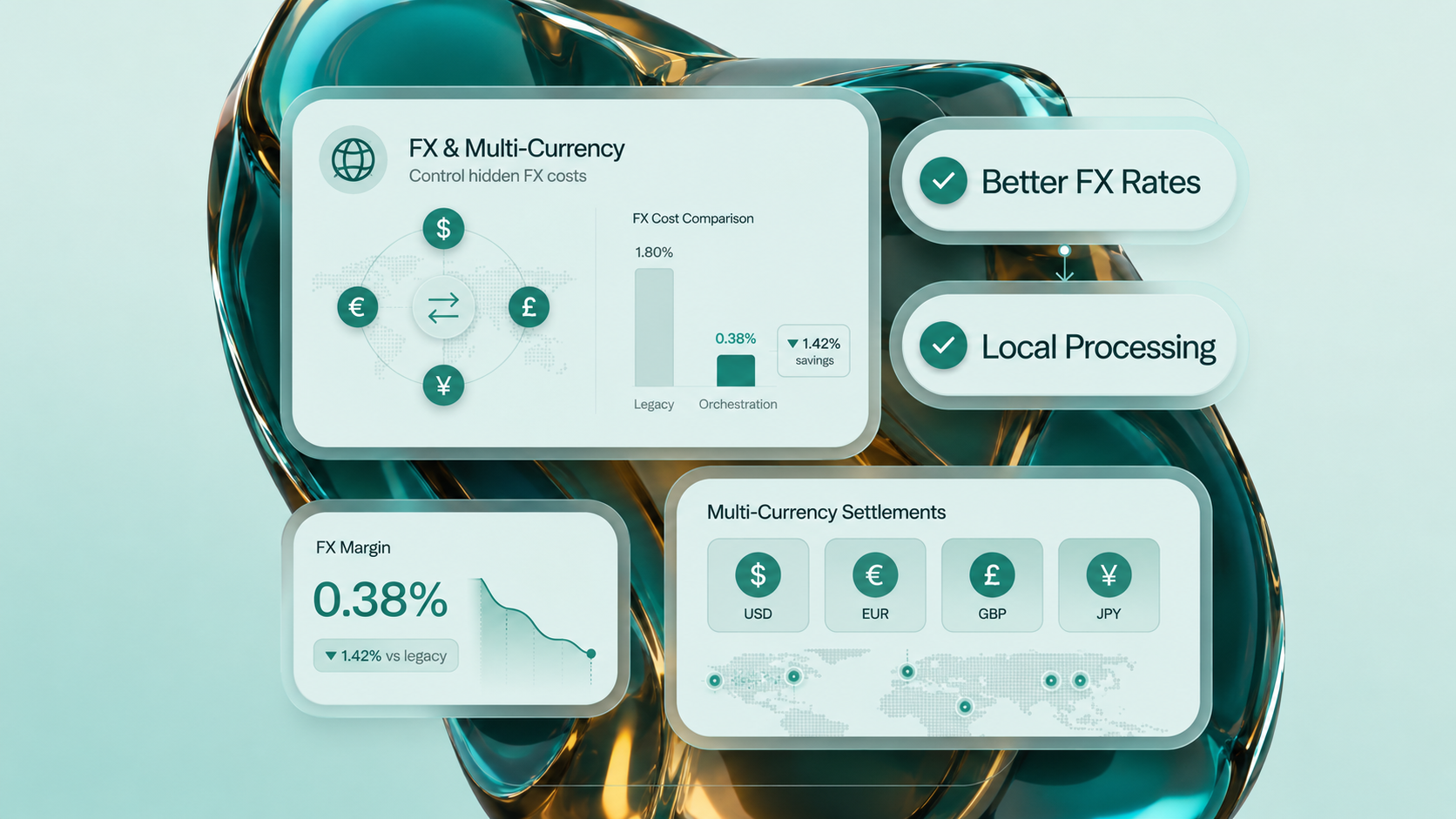
FX and Multi-Currency Settlements: The Quiet Cost Layer Most Merchants Stop Auditing Too Soon
Why foreign exchange margins are usually the largest unmanaged line in cross-border payment economics - and how orchestration turns FX from an accepted cost into a controllable variable.
Most merchants who operate internationally have audited their card fees, their interchange exposure, and their gateway costs in detail. They know what they pay per transaction. They've negotiated. They've optimised.
What they often haven't audited at the same level of seriousness is FX.
The reason is partly structural: foreign exchange margins are usually baked into a single all-in rate, presented as if they were a market constant. Partly cultural: FX is the part of the payment economics most merchants treat as something that happens to them rather than something they can shape. And partly informational: most providers don't make it easy to see exactly what margin is being applied to what transaction.
The result is that for many cross-border businesses, FX has quietly become the largest unmanaged cost in their payment stack. It moves with every international transaction. It doesn't show up in a single line item. And on volume, it represents real money, frequently more than the merchant's negotiated card processing margin combined.
Payment orchestration is the layer that changes this. By treating FX as a routable, comparable, optimisable variable, and by giving the merchant visibility into what's actually being applied, it turns one of the most invisible costs of going global into a competitive lever.
This article looks at what multi-currency settlement and FX actually cost when handled badly, how orchestration changes the picture, and what merchants should expect from a stack designed for genuine global scale.
What Multi-Currency Pain Actually Looks Like
The cost of fragmented multi-currency payments shows up in more places than most finance teams realise:
Hidden FX margins. Most payment providers quote an FX rate, but the rate they apply isn't the interbank or mid-market rate. It's the mid-market plus a margin. That margin is often opaque and rarely negotiable as part of a generic contract. On meaningful international volume, it can dwarf the negotiated card-processing fee that the merchant did fight hard for.
Reconciliation overhead. Each provider sends settlement files in its own format, on its own schedule, with its own currency-handling logic. Reconciling them by hand, particularly when the merchant is using multiple gateways across multiple markets, costs finance hours and creates error surface. Errors that aren't caught quickly become real cash differences.
Fragmented reporting. "How much did we make in EUR-denominated revenue last month, after FX, across all providers?" is supposed to be a simple question. In a fragmented stack, it's a half-day project. Decisions that should be made on data get made on estimates, with predictable consequences.
Customer-facing surprises. A customer in Tokyo who sees a price in yen and then sees a different number on their statement loses some confidence, both in the merchant and in their own decision to buy. Currency mismatches at checkout are a quiet but real driver of disputes and abandoned carts.
Working capital drag. Mismatched settlement schedules across providers and markets can leave large currency balances sitting in suboptimal places, doing nothing useful for the business.
Each of these is tolerable in isolation. Together, on scale, they typically cost the merchant more than the most visible payment costs they're actively managing.
What FX Is Actually Costing You
The simplest way to put the issue in perspective: FX margin is usually expressed as a percentage of every cross-border transaction. Even a margin that looks modest, well under one percentage point, compounds quickly when applied to substantial international volume.
For a merchant doing meaningful cross-border business, an honest audit usually surfaces a number that's larger than the team's intuition. The reason is that the cost is per-transaction, additive, applied silently, and never appears on the invoice with the label "FX margin."
The merchants who get serious about this typically discover two things at once:
- Their FX cost is bigger than they thought
- They have almost no levers to reduce it inside their current setup
That second point is the one orchestration solves.
How Orchestration Changes the FX Picture
Inside an orchestrated payment stack, multi-currency settlement stops being a single fixed cost and starts being a routable variable. Several specific mechanisms drive that:
Provider comparison in real time. The orchestration layer can route a transaction to the acquirer or processor offering the most competitive FX terms at the moment of transaction, not the one that happened to be integrated first.
Local processing where it makes sense. Many cross-border transactions don't need to be cross-border at all from a processing perspective. A customer paying in EUR through a local European acquirer often avoids the largest part of the FX margin entirely, with the conversion happening on the merchant's side at a better rate, or not at all, if the merchant settles in EUR.
Currency-of-settlement flexibility. Strong orchestration platforms let merchants settle in multiple currencies, choosing the optimal currency for each market based on their treasury strategy, rather than being forced to convert everything to a single home currency at whatever rate the provider applies.
Dynamic Currency Conversion done well. When customers genuinely want to see prices in their home currency, DCC is valuable. When it's applied indiscriminately as a margin-maximisation tool, it costs trust. The right orchestration layer makes DCC an option used surgically, not a default applied universally.
Transparency on what's actually happening. Per-transaction visibility into the rate applied, the margin charged, and the all-in cost of each conversion. This is the part most providers resist most, and it's the part that most directly turns FX from an unmanaged cost into a managed one.
The point isn't that FX disappears. Cross-border commerce involves currency conversion; someone is going to be doing it. The point is that the merchant gets a meaningful say in how it's done, by whom, and at what rate, instead of accepting whatever the integrated provider chose to apply.
What Customers Actually Want at Checkout
Beyond the merchant economics, multi-currency handling shapes the customer experience in ways that map directly to conversion:
Price displayed in the customer's local currency. Customers convert in their heads. When a checkout shows them an unfamiliar currency, friction increases, particularly for first-time purchases.
The price they're charged matching the price they were shown. This sounds basic. It's the single most common source of currency-related complaints and disputes.
Transparent FX, when FX applies. If the customer is paying in their own currency, fine. If a conversion is happening, telling them clearly is better than hoping they don't notice on their statement.
A checkout that feels native, not foreign. Localised currency is part of how a checkout signals that the merchant takes the customer's market seriously.
Done well, multi-currency handling is invisible to the customer: prices feel right, payments complete cleanly, statements match expectations. Done badly, it generates friction at exactly the moment when conversion is most fragile.
Reconciliation: The Operational Layer That Compounds
Beyond the per-transaction FX cost, the reconciliation problem is where orchestration produces some of its largest operational savings.
In a fragmented stack, reconciliation is a manual exercise across multiple providers, formats, currencies, and timing structures. Finance teams build elaborate spreadsheet workflows, hire dedicated headcount, and still routinely find discrepancies that take days to chase down.
In an orchestrated stack, reconciliation collapses into a single normalised view:
- All transactions, regardless of provider or currency, flow through one reporting layer
- Settlement files arrive in consistent formats
- FX conversions are tracked per transaction, with the underlying rate visible
- Cash positions across currencies are visible in one place
- Discrepancies surface automatically rather than getting buried
The savings here aren't only the time of the finance team. They're the decisions that get made better and faster when the underlying data is clean.
A Concrete Picture: How It Looks in Practice
Consider a UK-based merchant expanding into Japan and Brazil under two architectures.
Without orchestration. The merchant integrates a Japanese gateway for JPY transactions and a Brazilian one for BRL, alongside their existing UK acquirer. Each provider has its own dashboard, its own FX rate, its own settlement schedule. Each cross-currency transaction gets converted at whatever rate that provider applies. Finance pulls data from three sources monthly and pieces together a global view of revenue, costs, and FX exposure. Adding a fourth country means starting the process over.
With orchestration. The merchant integrates once. JPY transactions in Tokyo are routed through whichever acquirer is offering the best terms for that transaction at that moment; BRL transactions in São Paulo, similarly. FX is handled with visibility into the rate applied. Settlement consolidates into the merchant's chosen base currencies. The finance team gets one normalised view of global performance. Adding a fourth country is a configuration change, not an integration project.
The difference compounds across markets, transactions, and reporting periods. A merchant who's operated this way for two years occupies a different operating profile from one who hasn't.
What to Look For in Multi-Currency Capability
If FX and multi-currency settlement matter to your business, the questions to put to any payment partner are sharper than feature checklists:
- Where does your FX margin actually come from, and can you show me on a transaction-by-transaction basis?
- Can I settle in multiple currencies, and what's the structure for doing so?
- Do you support routing decisions based on FX rate, or only on approval rate?
- What does reconciliation look like across your integrated providers in practice?
- Is DCC offered as an option I control, or applied as a default I have to opt out of?
- Can I see live FX rate spreads across the providers you've connected me to?
- What's your approach to local processing versus cross-border processing?
These aren't gotcha questions. They're the diligence questions that distinguish a multi-currency setup that genuinely works from one that papers over FX as a fixed cost.
The Bottom Line
For most cross-border merchants, FX is the largest unmanaged line in their payment economics. It's not visible the way interchange is, not negotiable the way card processing fees are, and not audited the way most other costs of doing business are. And it scales with international growth, which means the more successful the expansion, the more FX is silently costing.
Payment orchestration makes FX a manageable variable rather than an accepted constant. Provider comparison, local processing, settlement-currency flexibility, transaction-level transparency, and clean reconciliation together transform multi-currency operations from a chronic cost centre into a strategic layer.
For a merchant serious about international scale, that shift is worth more than it usually looks like on paper, because it shows up everywhere, in every transaction, every month, compounding quietly.
At Paylinq, we help cross-border merchants take control of their FX and multi-currency operations through a single orchestration layer. Our clients route based on real-time FX terms as well as approval rates, settle in the currencies that match their treasury strategy, and reconcile across providers and markets in one normalised view. If you'd like to audit what FX is actually costing your business, and what cleaner multi-currency infrastructure could recover, get in touch with our team.
This article is provided for informational and educational purposes only and does not constitute financial, legal, tax, regulatory, treasury, or compliance advice. Specific operational, payment, FX, and treasury decisions should be made in consultation with qualified professionals familiar with your jurisdiction and business model. References to specific providers, currencies, markets, or scenarios are illustrative only and do not imply endorsement or guarantee. The authors and publisher accept no liability for actions taken based on this content. Information may become outdated as payment infrastructure, regulations, and market conditions evolve.
Simple. Fast. Reliable.
At Paylinq, we deliver a seamless experience with full transparency and effortless operations, so payments just work.
Social Handle
