
Payment Uptime
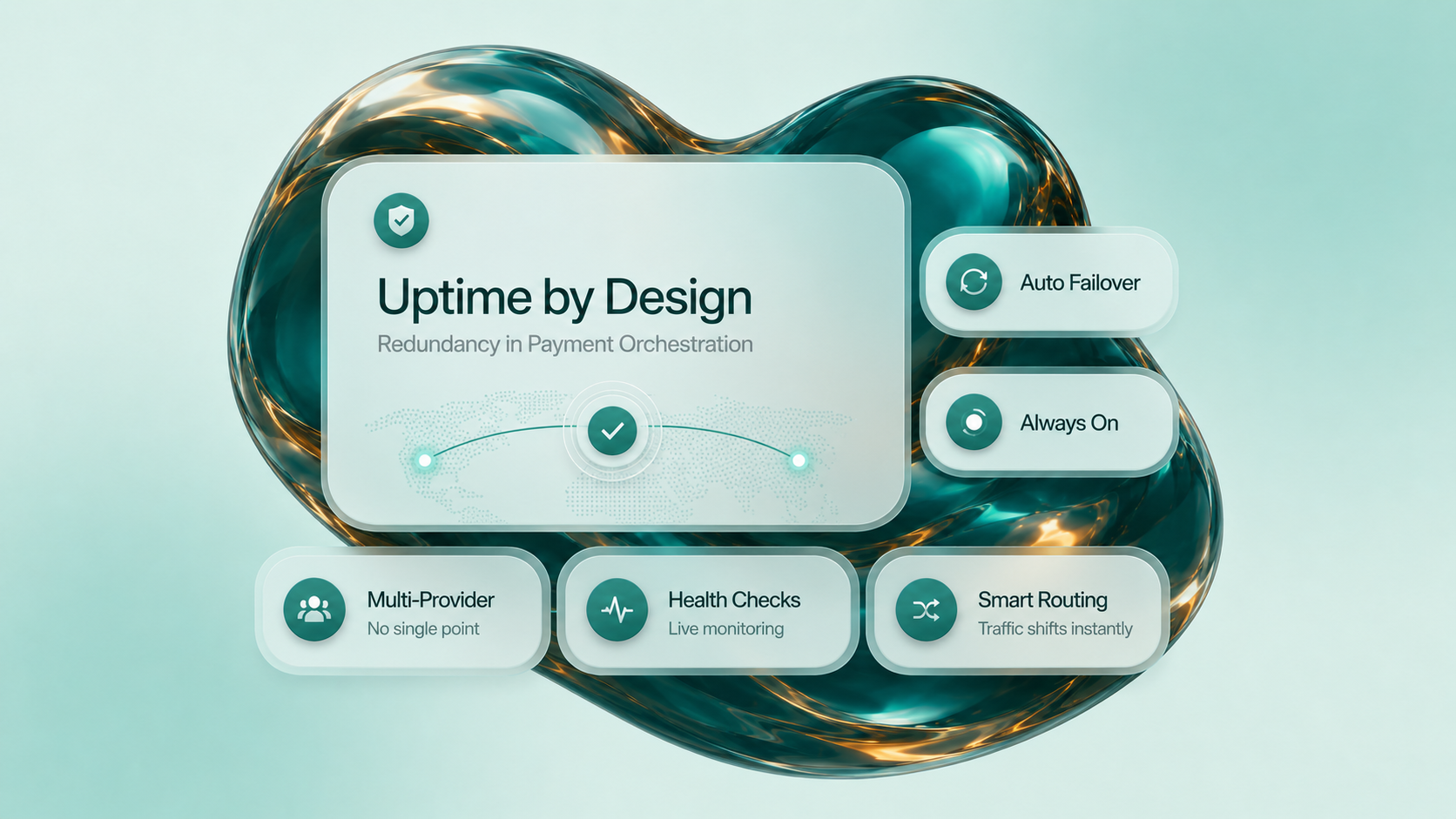
Designing for Failure: How Payment Orchestration Builds Real Uptime and Redundancy at Scale
Why single points of failure are the most expensive luxury in modern payments, and how the strongest stacks borrow their reliability principles from systems that genuinely can't afford to go down.
The aerospace industry, the telecom industry, and the cloud-infrastructure industry all share a design philosophy that payment infrastructure has been slow to adopt: assume components will fail. Build the system so that when they do, nothing the customer cares about goes down with them. Redundancy isn't a contingency. It's a baseline.
For most of the history of digital payments, this principle was honoured loosely. A merchant integrated with one acquirer, one gateway, maybe one fraud vendor, and trusted that those providers would keep working. When they didn't, the merchant accepted the downtime as bad luck, filed a ticket, and waited.
That model is becoming structurally untenable. Modern payment volumes are too high, customer expectations are too tight, peak windows are too valuable, and the cost of a single bad afternoon is too large for any business operating at scale to keep gambling on the assumption that nothing in the chain will fail. The question has shifted from will it fail to what happens when it does.
This is the work payment orchestration was built to do, not as a routing trick or an analytics layer, but as a redundancy architecture. The merchants treating it that way are building payment stacks that don't break when their providers do.
What Uptime Actually Costs When You Don't Have It
The cost of payment downtime gets underestimated for a specific reason: it doesn't show up as a single line in any P&L.
It shows up across many smaller lines that, taken together, are far larger:
- Lost transactions during the outage window, the obvious one
- Customers who tried, failed, and went elsewhere, and didn't come back
- Subscription renewals that failed and never recovered, breaking long-term revenue
- Dispute and support load that lingers for days afterward
- Acquirer relationship damage when chargeback ratios drift during a stress period
- Brand erosion that's hard to measure but real, especially in trust-sensitive sectors like iGaming and travel
For a merchant doing meaningful volume, even a short interruption, twenty minutes, an hour, can wipe out what most teams would consider a good week of optimisation work elsewhere.
The merchants paying serious attention to redundancy aren't the ones who've never had an outage. They're the ones who've had one, costed it honestly, and decided not to leave themselves exposed to the next one.
What Payment Orchestration Brings to Reliability
At its simplest, payment orchestration is the layer that connects multiple PSPs, acquirers, and gateways into a single coherent network, and decides, on a per-transaction basis, how each one should be handled.
The reliability story is what comes out the other side of that consolidation:
- No single provider is a single point of failure. When one acquirer degrades or goes offline, traffic shifts to another that's still healthy.
- Failover is automatic, not manual. Engineering teams don't get paged at 3am to flip a switch; the orchestration layer flips it itself.
- Retries are intelligent, not naive. A failed authorisation can be retried against an alternative path with parameters tuned to the actual reason it failed.
- Health is continuously monitored. Provider state is part of routing logic, not something to discover after the fact.
The architectural shift is from a serial pipeline, transaction to one path to outcome, to a portfolio with built-in alternatives, transaction evaluated against multiple paths to optimal outcome based on live conditions.
That shift is what makes orchestrated payment stacks operationally different from traditional ones, even before any of the more advanced capabilities come into play.
How Uptime Actually Gets Improved Inside an Orchestration Layer
The mechanics underneath aren't mysterious. They're a set of specific behaviours running continuously:
Smart failover routing. Each transaction has more than one viable path. When the primary fails, for technical, network, or risk reasons, the layer reroutes immediately rather than returning a final decline.
Real-time provider health checks. Approval rates, latency, and error rates are tracked second by second per provider. A provider whose performance is dropping receives less traffic until it recovers. This happens before customers feel anything.
Load balancing across acquirers. No single acquirer absorbs the entire flow. Distribution stays even, or weighted intentionally, so that no provider's capacity becomes the bottleneck during peaks.
Dynamic retry logic. Failed authorisations get a second look. Sometimes that means retrying through a different acquirer; sometimes it means retrying with different parameters. Either way, recoverable failures don't get logged as final losses.
Configurable rules. Business rules can shape routing, preferring certain acquirers in certain markets, routing high-value transactions through stricter paths, treating recurring billing differently from one-off purchases.
The goal of all of this is plain: keep the system processing transactions cleanly, even when individual components are misbehaving.
Multi-Provider Routing as the Backbone of Redundancy
Multi-provider routing is the structural feature that makes everything else possible. Without it, no amount of clever logic can help. There's nothing to route to.
The pattern looks like this in practice:
- Acquirer A handles a particular slice of traffic well, say, UK-issued cards on certain BIN ranges
- Acquirer B is the backup for that slice, ready to take over instantly if A degrades
- Acquirer C is the primary for a different slice, perhaps cross-border traffic to specific markets
- The orchestration layer manages the whole portfolio, distributing transactions in real time based on live performance
The result is that the merchant has no single acquiring relationship that could take their payments down. The chance of all paths failing simultaneously is dramatically lower than the chance of any one of them failing, and orchestration makes that mathematical advantage operational.
This is also where redundancy stops being purely defensive and starts paying offensive dividends. The same multi-provider setup that protects against outages can be used to lift approval rates, reduce fees, and route around regional weaknesses, by sending each transaction to the path most likely to succeed for its specific characteristics, not just the path that happens to be available.
What Reliable Architecture Actually Looks Like
Genuine orchestration-level reliability rests on three concrete properties, and the merchants who get this right invest in all three:
Scalability. The system handles 10x peak volume without latency creeping up or failover behaviour breaking down. Reliability under load is a different problem from reliability at average volume, and it's the load condition that actually tests the design.
Observability. Every layer of the stack, provider health, transaction outcomes, latency, retry rates, failover triggers, is visible in real time. Reliability you can't see is reliability you can't trust.
Automation. Decisions about where to route, when to fail over, and how to retry happen in milliseconds, not minutes. Anything that requires human intervention during an incident is anything that won't happen during an incident.
A stack with all three has eliminated single points of failure as a structural concern. A stack missing any of them is one bad afternoon away from learning which one mattered most.
The Business Case for Redundancy
The technical advantages of redundancy are easy to describe. The business case is where merchants tend to get it wrong, usually by underestimating how much they're already paying for the absence of it.
What strong redundancy actually delivers:
Revenue continuity. Transactions keep flowing through provider issues that would otherwise show up as outage windows. The line on the chart stays smooth where, in a single-provider setup, it would have dropped.
Customer trust that compounds. Customers don't notice reliability when it's working. They only notice its absence. But the absence is what drives churn, abandonment, and reputational damage. Reliable systems quietly accumulate trust transaction by transaction.
Cleaner expansion. Adding new markets or new payment methods is far less risky when the underlying architecture is already designed for redundancy. Each new integration is one more option, not one more potential failure.
Lower operational drag. Engineering teams spend less time firefighting and more time on the work that actually moves the business forward. The cost of not having redundancy isn't just incident response. It's all the optimisation work that incident response keeps eating.
Better leverage in commercial conversations. A merchant whose business doesn't depend entirely on any single acquirer negotiates differently from one whose does.
In aggregate, redundancy pays for itself many times over, and most of that ROI is invisible because it shows up as the absence of problems rather than the presence of fixes.
How Strong Operators Actually Build for Uptime
The merchants who genuinely get this right share a few habits that consistently separate them from peers operating on weaker infrastructure:
- They integrate multiple PSPs and acquirers as a foundational design choice, not as a reaction to an incident
- They define routing rules that treat provider health as a first-class signal, not an occasional consideration
- They monitor performance at granular level, by provider, region, BIN, method, and respond to drift early
- They test failover behaviour proactively, including simulated outages, not just real ones
- They review post-incident learnings systematically and translate them into routing and architectural changes
- They treat redundancy as part of capacity planning, not as a separate exercise from capacity itself
None of these is a single decision. They're an ongoing engineering posture, one that pays off most precisely when it's least visible.
Where Reliability Engineering in Payments Is Heading
Two trends are shaping the next phase of payment reliability:
Predictive routing. Rather than waiting for a provider to degrade and then reacting, the next generation of orchestration uses pattern recognition to anticipate degradation and shift traffic before the impact lands. AI-driven routing isn't a marketing buzzword in this context. It's the natural extension of treating provider health as a continuously evolving signal.
Cross-vertical redundancy patterns. Reliability principles that have matured in iGaming, where deposit failures are unforgivable, and travel, where booking windows are tight and global, are spreading across e-commerce, marketplaces, and B2B payments. Each vertical contributes its specific lessons to a shared engineering vocabulary.
The merchants who anticipate where this is going are the ones already designing their stacks around the assumption that components will fail, and engineering the system so it doesn't matter.
The Bottom Line
Single points of failure are the most expensive luxury in modern payments. The merchants who can afford them, by which I mean, the merchants who actually pay the price of having them, in lost revenue, lost customers, and lost trust, are the ones who haven't yet costed an outage honestly.
Payment orchestration solves this not as an analytics tool or a routing trick, but as an architecture for redundancy. Multiple providers, intelligent routing, automatic failover, real-time observability, all working together to keep the system running through conditions that would take a simpler stack offline.
In a market where the gap between reliable and unreliable payment infrastructure is widening every year, building for failure isn't pessimism. It's how durable businesses get built.
At Paylinq, we build payment infrastructure designed around the assumption that providers will sometimes fail and the recognition that businesses can't afford to. Through a single orchestration layer, our clients connect to multiple acquirers, route dynamically across markets and methods, fail over automatically when something degrades, and maintain visibility into the whole stack as it runs. If you'd like to map out what stronger uptime and redundancy would look like for your operation, get in touch with our team.
This article is provided for informational and educational purposes only and does not constitute financial, legal, tax, regulatory, or compliance advice. Specific operational, payment, and architectural decisions should be made in consultation with qualified professionals familiar with your jurisdiction and business model. References to specific industries, providers, or scenarios are illustrative only and do not imply endorsement or guarantee. The authors and publisher accept no liability for actions taken based on this content. Information may become outdated as payment infrastructure, regulations, and market conditions evolve.
Simple. Fast. Reliable.
At Paylinq, we deliver a seamless experience with full transparency and effortless operations, so payments just work.
Social Handle
