
Payout Infrastructure
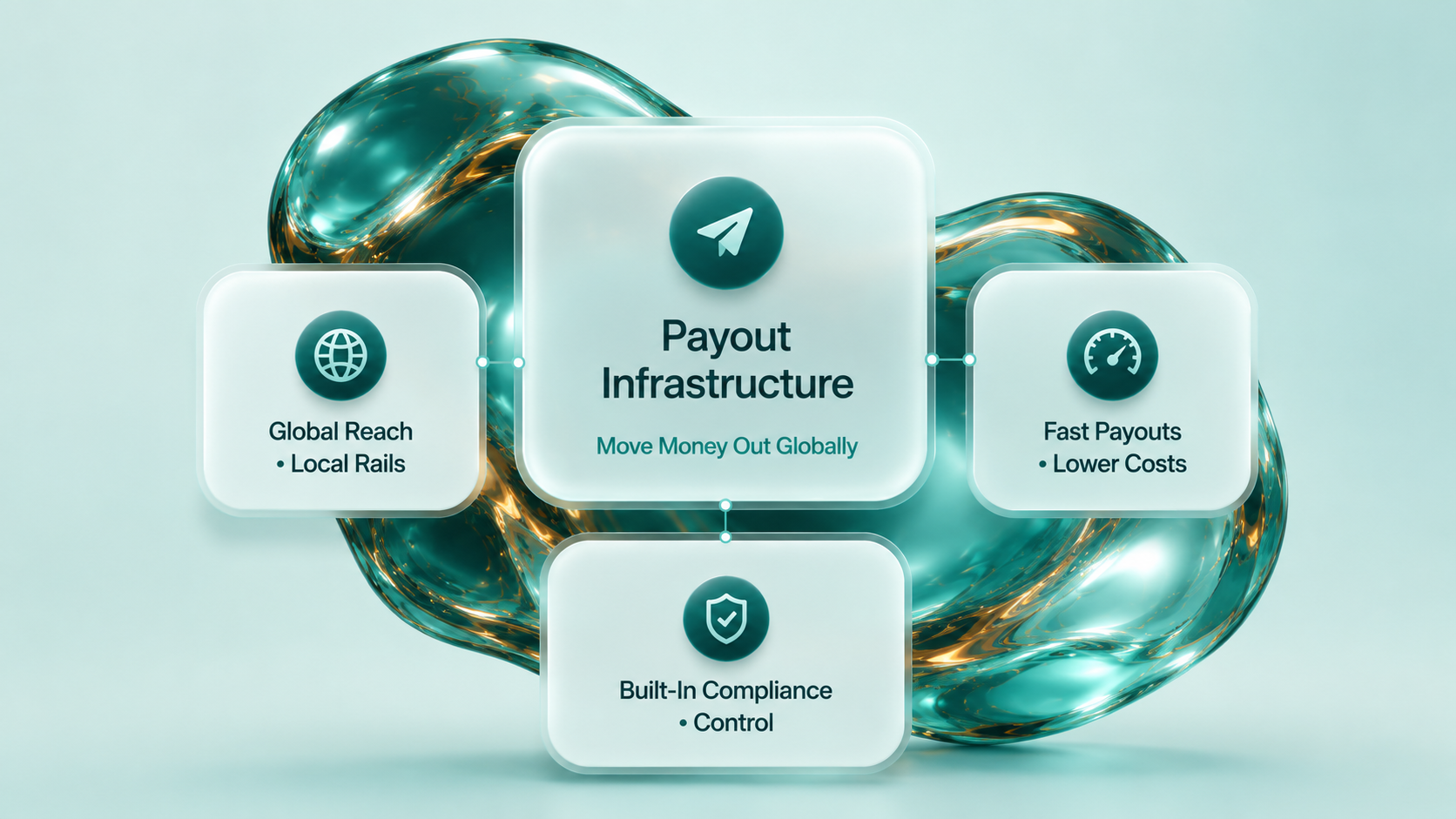
Payout Infrastructure: How Modern Businesses Actually Move Money Out
The often-overlooked half of payments, and why getting it right has become as strategic as how you take money in.
For most of the last decade, payments conversations have been dominated by inbound flow. How do we accept more cards, more wallets, more local methods? How do we lift approval rates? How do we cut friction at checkout?
Those are still important questions. But they describe only one direction of the financial flow most modern businesses now run. Money also has to leave, to suppliers, sellers, drivers, creators, freelancers, partners, players, and customers, and increasingly that money has to leave quickly, accurately, in dozens of currencies, across regulatory borders, with full audit trails on the way out.
This is the payouts problem. And for any business operating at scale across more than one country, it's no longer a back-office logistics task. It's a piece of infrastructure that directly shapes how fast the business can grow, how much trust it earns from the people it pays, and how cleanly it can manage cost and compliance at the same time.
The companies that take this seriously have stopped thinking about payouts as a finance department workflow and started thinking about them as a product feature.
Key Takeaways
- Modern payouts demand far more than bank transfers. They require routing intelligence, automation, and global rail coverage.
- A proper payout platform unifies banking relationships, FX handling, compliance, and reporting into a single coordinated flow.
- Cross-border payout solutions reduce cost, accelerate settlement, and strip out the operational complexity of running country-by-country setups.
- Marketplaces, gig platforms, iGaming, SaaS, e-commerce, travel, and financial services all run on outbound payments at scale.
- Strong payout infrastructure is a growth lever, not just a cost line. It shapes how quickly businesses can enter new markets and how loyal their partners stay.
What Payout Infrastructure Actually Is
A payout solution, in its simplest form, is the financial plumbing that lets a business send money to recipients around the world reliably, quickly, and with the right controls in place. The "simplest form" framing is deceptive, though. What looks like a single instruction, "send €500 to this person in Portugal", touches a surprisingly long list of moving parts underneath:
- A funding source the merchant holds
- A connection to one or more banking partners
- A choice of payment rail, SEPA Instant, FPS, ACH, PIX, UPI, Interac, local instant schemes, etc.
- An FX engine, if the source and destination currencies differ
- Compliance and screening checks against the recipient
- Validation of the payout details before money moves
- Reconciliation back into the merchant's books once it lands
A modern payout platform takes all of those concerns and consolidates them. The merchant submits a payout request; the platform decides how to fulfil it; the recipient receives the funds in the form they expect; and the merchant gets a clean record of what happened.
That consolidation is what separates a payout system from a tangle of bank accounts, spreadsheets, and approval queues.
What Happens Underneath When a Payout Goes Out
Walk through what a strong payout platform actually does in the few seconds between "merchant clicks send" and "recipient sees the money":
- Receive the request with the payout amount, currency, recipient, destination, and any business context, commission, refund, supplier invoice, gig payment.
- Validate the recipient details against the format expected by the destination rail, IBAN structure, routing number, BIC, mobile-wallet ID, whatever the local scheme requires.
- Run compliance checks, sanctions screening, PEP checks, regional rule handling, and any merchant-specific risk rules.
- Choose the rail based on cost, speed, and availability. SEPA Instant for an EU-to-EU euro transfer; PIX for Brazil; UPI for India; FPS in the UK; local ACH schemes elsewhere; correspondent banking only when there's no better option.
- Apply FX if the source and destination currencies differ, with a rate that's actually competitive rather than absorbed in opaque margin.
- Execute the payout through the chosen rail.
- Track and reconcile the result, surface any failures clearly, and update the merchant's reporting in real time.
To the merchant, this is a single API call or one click in a dashboard. The orchestration that makes it feel that simple is doing real work underneath.
Who Actually Lives or Dies on This
Payout infrastructure shows up across more industries than people typically realise. A short, non-exhaustive tour:
Marketplaces paying sellers, service providers, and freelancers across multiple countries, often weekly or daily, where consistent, on-time payouts are a core part of seller retention.
Gig and creator economy platforms where the difference between same-day and three-day payouts directly affects whether drivers, riders, couriers, or creators stay engaged with the platform.
iGaming and sports betting, where withdrawal speed is, frankly, part of the product. Players judge platform trustworthiness by how cleanly money comes back out.
SaaS and platform businesses that share revenue with partners, affiliates, or app developers and need to do it reliably across many jurisdictions.
E-commerce handling supplier settlements, refunds at scale, and affiliate or influencer payouts.
Travel and hospitality, where commissions, refunds, and operator settlements move across markets and currencies on a continuous basis.
Financial services, including insurance, lending, and benefits disbursement, where outbound payments are sometimes the entire product.
Different verticals, same underlying need: outbound money movement that's fast, accurate, compliant, and trackable at scale.
What Strong Payout Infrastructure Actually Does for the Business
It's tempting to evaluate payout platforms purely on speed and cost. Both matter, but the broader benefits show up across several dimensions:
Faster settlement. Payouts that used to take days now arrive in minutes or hours over instant rails. For recipients in cash-flow-sensitive roles, drivers, couriers, creators, freelancers, this changes their relationship with the platform paying them.
Lower cost per payout. Local rail access cuts cross-border fees that traditional correspondent banking applies almost reflexively. Smarter FX shaves further on currency conversion.
Operational simplification. A single platform replaces a stack of bank portals, spreadsheets, manual approval steps, and reconciliation workflows. The headcount cost of "payouts ops" stops scaling linearly with payout volume.
Built-in compliance. Sanctions screening, KYB checks on payees, regional rule handling, and full audit trails happen automatically rather than as separate manual processes.
Higher accuracy, fewer failed payments. Validation at submission catches bad details before they cost time and goodwill. When something does go wrong, the failure is surfaced quickly with enough context to fix it.
Stronger trust with the people getting paid. The single biggest invisible benefit. Reliable, predictable payouts are how a platform earns long-term loyalty from sellers, drivers, players, and partners.
The point isn't that any one of these is transformative on its own. It's that together they shift payouts from a cost centre to an operational asset.
Why Payout Infrastructure Is a Growth Lever, Not a Logistics Tool
For businesses moving into new countries, payout infrastructure often becomes the practical limit on how fast that move can happen.
Without it, expansion looks like opening new banking relationships, integrating local schemes one by one, dealing with currency exposure, building reconciliation pipelines, and absorbing the legal and compliance overhead of each new jurisdiction. With the right platform, most of that work is already done. Entering a new market becomes a matter of switching on coverage that already exists.
That changes the economics of growth in a few specific ways:
- Time to market shortens dramatically when payouts in a new country don't require a new banking integration project.
- Partner ecosystems strengthen because new sellers, drivers, or creators in that market get paid reliably from day one.
- Cash flow improves because faster payouts shorten the working-capital cycle on both sides.
- Reporting stays clean as volume grows, because every payout in every region lands in one ledger.
- Margins improve when smarter routing and FX reduce per-transaction cost without manual intervention.
The merchants getting this right have effectively turned outbound payments into a quiet competitive advantage, not because anyone notices the payouts working, but because everyone notices when they don't.
What to Look For in a Payout Partner
Payout providers are not interchangeable, and the differences matter most precisely when scale starts to bite. A few areas to look at carefully:
Global reach. How many countries, currencies, and corridors are actually live, not just listed on a marketing page. Real coverage includes the awkward markets, not only the easy ones.
Local rail access. Direct connections into instant schemes, SEPA Instant, FPS, PIX, UPI, Interac e-Transfer, and the local equivalents, make a real cost and speed difference compared with correspondent banking fallbacks.
FX handling. Does the platform offer transparent, competitive rates and tools to manage currency exposure, or is FX margin where the cost actually hides?
Compliance depth. Automated sanctions screening, PEP checks, jurisdiction-specific rule handling, and clean audit trails. Compliance built in, not bolted on.
Smart routing. The ability to choose between rails based on speed, cost, success rate, and time of day for each individual payout, and to fall back gracefully when a primary route is unavailable.
Unified reporting. One dashboard, one ledger, one reconciliation source for every payout across every region. Splintered reporting is a hidden tax that scales painfully with volume.
API-first design. Payouts that can be embedded directly into the merchant's product, not just initiated from a dashboard. For platforms paying many recipients, this is non-negotiable.
Operational support. When a payout doesn't behave as expected, and at scale, some will, there's a real difference between a vendor that surfaces the problem with context and one that hands the merchant a generic error.
The combination is what defines a serious payout partner. Any one of these on its own can look adequate; the gaps usually show up at the points where two or more need to work together.
The Bottom Line
Outbound payments have quietly become as operationally important as inbound ones. The merchants paying attention have stopped treating payouts as a finance team's plumbing problem and started treating them as infrastructure that shapes growth, trust, and unit economics.
Done well, payouts are invisible. Recipients get their money, the merchant gets a clean record, the system handles routing, FX, and compliance underneath, and nobody has to think about it. Done badly, they generate exactly the kind of friction that drives away the people a platform most needs to keep.
The shift from "can we send the money" to "can we send it intelligently, at scale, in every market we operate in" is one of the defining infrastructure questions for cross-border businesses heading into the next stage of growth.
At Paylinq, we help merchants move money outward as cleanly as they take it in. Through a single platform, our clients access broad global rail coverage, optimised FX, integrated compliance, and smart routing, all under unified reporting that scales as the business grows. If you'd like to map out what stronger payout infrastructure would look like for your operation, get in touch with our team.
This article is provided for informational and educational purposes only and does not constitute financial, legal, tax, regulatory, or compliance advice. Specific operational, payment, and treasury decisions should be made in consultation with qualified professionals familiar with your jurisdiction and business model. References to specific payment rails, schemes, providers, or scenarios are illustrative only and do not imply endorsement or guarantee. The authors and publisher accept no liability for actions taken based on this content. Information may become outdated as payment infrastructure, regulations, and market conditions evolve.
Simple. Fast. Reliable.
At Paylinq, we deliver a seamless experience with full transparency and effortless operations, so payments just work.
Social Handle
