
Global Payments
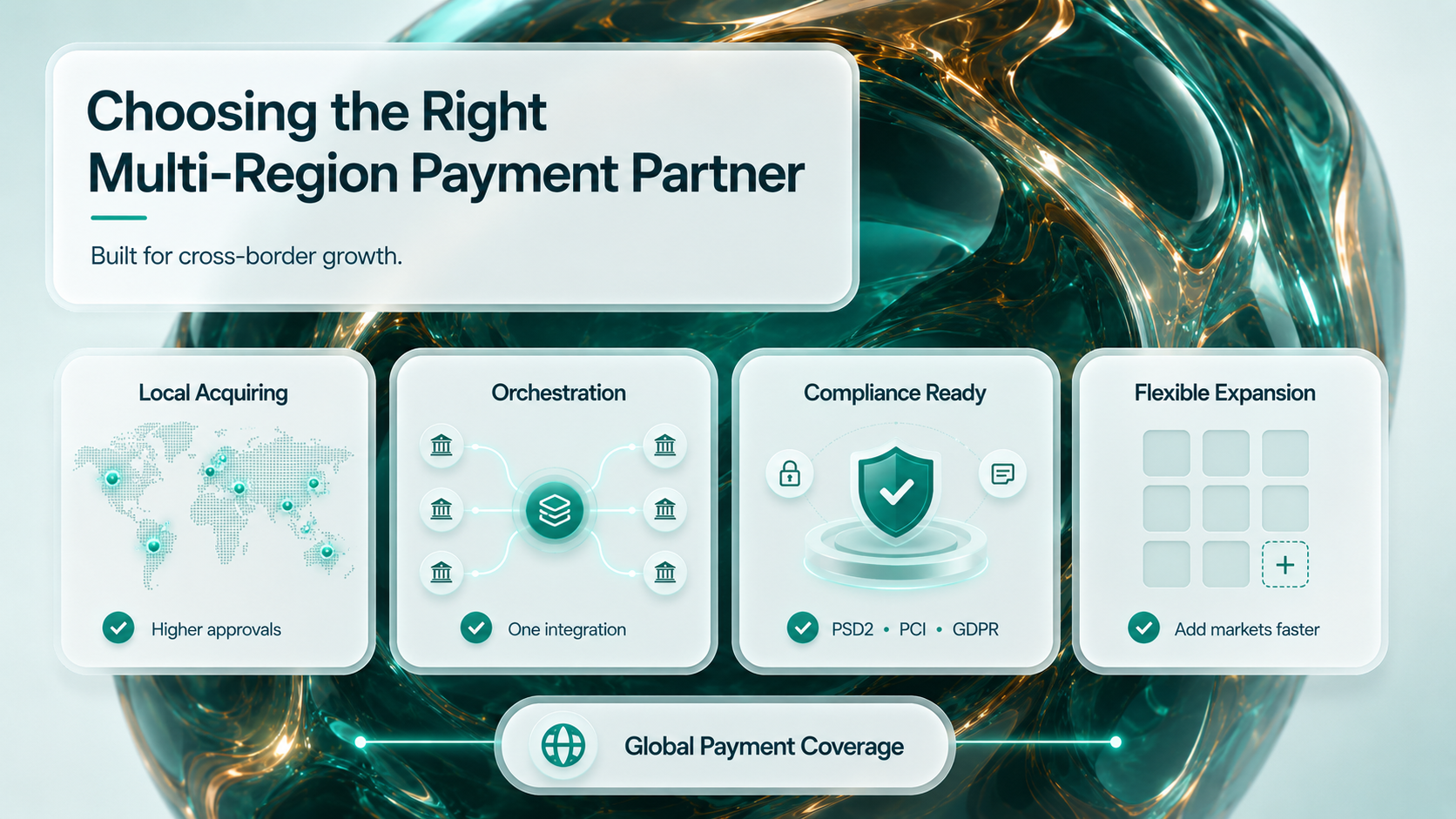
Choosing a Multi-Region Payment Partner: A Practical Framework for Merchants Going Global
Why most merchants pick payment providers the wrong way, the questions that actually matter, and how to evaluate a partner who can handle three years of growth - not just the first integration.
The decision to expand internationally is rarely held back by product, marketing, or strategy. It's most often held back - quietly, expensively - by payment infrastructure that wasn't chosen with multi-region growth in mind.
The pattern is recognisable. A merchant picks a payment provider that handles their home market well, ships into a couple of neighbouring countries, and discovers that approval rates have quietly dropped, local methods are missing, currency handling is awkward, and adding the next country requires a project plan rather than a configuration change. The provider isn't bad. It just wasn't the right choice for this business at this stage of growth.
Picking a payment partner isn't a feature comparison exercise. It's a decision about who you want to operate with for the next three to five years, in markets you may not have entered yet, under conditions you can't fully predict. Most merchants underweight that and pay for it later.
This article is a practical framework: the questions worth asking, the gaps to look for, the red flags that show up early if you know to watch for them, and the difference between providers built for single-market processing and those genuinely built for cross-border growth.
The Questions You Should Actually Be Asking
Most evaluation conversations are dominated by feature checklists. Useful, but not where the real differences live. The questions that actually predict whether a partner will work for a multi-region business sit elsewhere:
How does this provider perform on the specific traffic profile you're going to give them? Approval rates aren't a single number. They vary by market, BIN, card type, currency, time of day, and risk profile. A provider with a great global average can still underperform on the slice of traffic that's yours.
What does adding a new country actually look like? Not "we support that country" - that line is on every provider's deck. The question is what the merchant has to do, how long it takes, what local acquiring relationships are available, what local payment methods are included, and what compliance work transfers automatically versus what becomes a fresh project.
Where do they put real engineering effort, and where don't they? Every provider invests selectively. Some are deeply invested in local acquiring across many markets; some are excellent in one or two regions and thin elsewhere. Some have mature orchestration capabilities; some are essentially a single PSP with marketing copy. Knowing where their actual investment lives matters more than what their feature page says.
How do they handle their own failures? Outages happen. Approval rates dip. Local rails misbehave. The honest question isn't "do you ever have problems" - everyone does. It's "how will I find out about them, how quickly, and what does your team do when they happen?"
What does month 18 look like, not just month 1? Onboarding is the easy part. The relevant test is how the partner performs after volume scales, after the integration matures, after the merchant moves into markets that weren't on the roadmap when the contract was signed.
These questions don't have neat answers on a feature page. They surface in real conversation - with people who know what they're doing - and the quality of those conversations is one of the strongest signals of whether a partner can actually carry a business through international growth.
What Multi-Region Capability Genuinely Looks Like
The phrase "global payment processing" is on essentially every provider's website. The substance varies dramatically. A few markers separate genuine multi-region capability from packaging:
Local acquiring depth. A provider with international card support is not the same as a provider with local acquiring relationships in your target markets. Local acquiring lifts approval rates, lowers cross-border fees, and makes the customer's bank treat the transaction as domestic rather than international. The list of countries with true local acquiring matters more than the list of countries technically "supported."
Local payment methods that go beyond the obvious. Apple Pay and Google Pay everywhere is table stakes. Real coverage means BLIK in Poland, MB Way in Portugal, iDEAL in the Netherlands, Bizum in Spain, Swish in Sweden, Pix in Brazil, UPI in India, Alipay and WeChat Pay in China, Boleto and other regional schemes wherever they actually drive conversion. Coverage of the easy markets isn't the test. Depth in the awkward ones is.
Currency handling that doesn't surprise customers. Showing prices in one currency and charging in another quietly destroys trust. Strong providers offer real-time rates, customer-currency display, multi-currency settlement, and clean reconciliation across the whole flow. Currency transparency isn't a feature - it's a basic operational requirement.
Compliance handled across jurisdictions, not market by market. PSD2/SCA in Europe, PCI DSS globally, GDPR for data, AML rules that vary by market, and the patchwork of country-specific requirements that show up in iGaming, financial services, and crypto. A serious cross-border provider absorbs much of this complexity rather than passing it through to the merchant.
Tokenisation and credential portability. Network tokenisation, vaulted credentials that travel with the merchant if commercial terms change, and clean migration paths. The merchants who get locked into providers most painfully are usually the ones whose card-on-file vault sits inside that provider's environment with no clean exit.
When a provider has these things in real depth - not as marketing claims - the merchant's expansion costs drop sharply. When they don't, every new market becomes a project.
Why Orchestration Has Become the Default Architecture
A subtle but important shift in how serious merchants think about this: the question increasingly isn't "which single PSP should I pick?" - it's "what orchestration architecture do I want, and which providers fit inside it?"
The reason is straightforward. A single-PSP setup forces every transaction through one path, in one acquirer relationship, with one fee structure, one fraud profile, and one outage profile. That works for small, single-market merchants. For a business operating across multiple regions, it concentrates risk and caps performance.
Payment orchestration changes the architecture. Instead of choosing one provider and accepting their constraints, a merchant connects to multiple acquirers and PSPs through a single integration layer. Routing decisions are made per transaction. Failover is automatic. Local acquiring lives where it makes sense. New markets and new methods can be added through configuration rather than re-integration.
For multi-region merchants, this isn't a "nice to have" architectural preference - it's increasingly the only architecture that scales. The choice of partner shifts to: who can give me orchestration depth, plus the underlying connectivity, plus the operational support to run it well?
What Real Compliance Capability Looks Like
Compliance is one of the areas where the gap between marketing and reality is widest. Every provider claims to handle it. The relevant questions are sharper:
- PSD2 and SCA: how is exemption logic actually managed, and how is it tuned over time?
- PCI DSS: how does the provider's setup affect your PCI scope? Reducing it is a genuine benefit; merely meeting their own obligations is not.
- GDPR and data residency: where does customer data physically live, and what controls do you have over it?
- AML and sanctions screening: built into the platform or a separate vendor responsibility?
- Local regulatory frameworks: especially in iGaming, crypto, financial services, and travel, where rules vary by jurisdiction and shift frequently.
The strongest providers reduce compliance complexity actively. The weakest pass it through and leave the merchant to figure it out.
Smart Routing, Redundancy, and the Operational Posture That Goes With Them
Smart routing and redundancy aren't features that exist in isolation. They depend on a particular operational posture from the provider - one that not every vendor maintains in practice.
What you're looking for, beyond the technical capability:
- Real-time provider health monitoring that drives routing decisions, not just reports
- Failover behaviour that's been tested under realistic conditions, not theoretical
- Retry logic with substance - not "try again on the same path" but intelligent retries through alternative acquirers with parameters tuned to actual decline reasons
- Regional preference settings that let merchants encode their commercial logic rather than fighting against the platform's defaults
- Performance data exposed clearly, with enough granularity to identify where improvements are possible
When all of these are present, smart routing produces measurable lift in approval rates and material reduction in outage exposure. When they're advertised but missing in substance, the lift doesn't show up in the data.
Platform Flexibility: The Quiet Predictor of Long-Term Fit
Among the questions merchants under-weight, platform flexibility is probably the most important.
Three years from now, your business will be running payment flows you can't currently anticipate. New markets, new payment methods, new product lines, new commercial relationships, new compliance requirements. The provider who fits well in year one but requires major engineering work for every change in year three is the wrong partner - even if the year-one experience felt smooth.
What flexibility actually looks like:
- Modular APIs that let teams compose flows rather than accept hardcoded paths
- Configuration over code for region-specific rules, risk thresholds, and routing preferences
- Sandbox environments that let new markets be tested before they're launched
- Custom risk tooling and rule engines that integrate with what you already use
- A/B testing capabilities at the routing and provider level
- Clean migration paths if any specific provider relationship needs to change
If every reasonable change requires a multi-month engineering project, the platform isn't flexible. It's a constraint dressed up as infrastructure.
Industry Fit Matters More Than Most Merchants Think
Different sectors run on different payment realities, and a partner who genuinely understands the specific shape of your industry's flows is worth more than one with broader but shallower coverage.
Travel and ticketing. High volumes, dynamic pricing, refund-sensitive models, and tight booking windows. Cross-border by default. Failed payments don't just cost a sale - they sometimes cost a flight. Smart routing, local acquiring, and real-time risk screening are non-negotiable.
E-commerce. Speed, trust, and conversion-window sensitivity dominate. Local payment methods drive country-specific lifts that no single global method matches. Peak periods test the entire stack at once.
SaaS, subscriptions, and digital platforms. Recurring billing dynamics dominate. Failed renewals are silent churn. Tokenisation, intelligent retries, and lifecycle management are essential rather than optional.
iGaming and sports betting. Regulatory complexity is severe and varies by market. Deposit speed directly affects engagement. Withdrawal reliability shapes long-term player trust. KYC integration, compliance depth, payout flexibility, and orchestration sophistication all matter independently - and combine into a profile most providers can't actually deliver.
Marketplaces and platforms. Multi-currency, multi-region payouts are a defining feature. Strong outbound infrastructure matters as much as inbound.
A partner who's done real work in your vertical doesn't just hand you tools. They surface patterns you wouldn't have known to look for - the fraud vectors specific to your sector, the seasonal dynamics, the markets where your particular product type performs differently from the global average.
The Difference Between a Vendor and a Partner
The cleanest test of whether a payment provider is the right fit is one many merchants only apply after the fact: does this company act like a vendor delivering a product, or like a partner co-engineering an outcome?
The signals show up in specific places:
- In how they answer hard questions. Vendors deflect; partners give you context.
- In how they handle problems. Vendors send error codes; partners send context with a path forward.
- In how they handle commercial conversations. Vendors negotiate transactions; partners think about your unit economics with you.
- In whether they tell you about issues you don't yet see. Vendors react; partners alert.
- In what they share about other merchants in your vertical. Not breaching confidentiality, but recognising patterns and pointing you to lessons others have learned.
- In whether their support team knows your business. Or whether you start every conversation explaining what you do.
A merchant operating across multiple regions, with real volume, in a competitive market, can't afford a vendor relationship masquerading as a partnership. The cost of the wrong choice doesn't show up in the contract. It shows up in the slow drift of approval rates, the time engineering teams spend working around the platform, and the markets that take twice as long to enter as they should have.
The Bottom Line
Choosing a payment partner for a multi-region business is one of the higher-leverage infrastructure decisions a growing merchant makes. The features matter. The pricing matters. But the deeper variables - orchestration depth, local acquiring substance, compliance posture, platform flexibility, industry fit, and partnership orientation - matter more, because they determine how much value the relationship produces over the years that follow the integration.
The merchants who get this right end up with infrastructure that quietly compounds: each new market is faster than the last, each performance gain reinforces the next, and the payment stack stops being a constraint on growth and starts being one of its drivers.
The ones who get it wrong end up rebuilding sooner than they planned, often at scale and under pressure.
The framework matters. The questions matter. The conversations you have before the contract is signed matter most.
At Paylinq, we work with merchants serious about cross-border growth - not as a vendor delivering a checkout integration, but as an infrastructure partner. Through a single orchestration layer, our clients access multi-acquirer routing, deep local payment-method coverage, currency handling that protects customer trust, and dedicated operational support that grows with the business. If you'd like to talk through what a stronger multi-region setup would look like for your operation, get in touch with our team.
This article is provided for informational and educational purposes only and does not constitute financial, legal, tax, regulatory, or compliance advice. Specific operational, payment, and commercial decisions should be made in consultation with qualified professionals familiar with your jurisdiction and business model. References to specific industries, providers, methods, or scenarios are illustrative only and do not imply endorsement or guarantee. The authors and publisher accept no liability for actions taken based on this content. Information may become outdated as payment infrastructure, regulations, and market conditions evolve.
Simple. Fast. Reliable.
At Paylinq, we deliver a seamless experience with full transparency and effortless operations, so payments just work.
Social Handle
