
Payment Mix
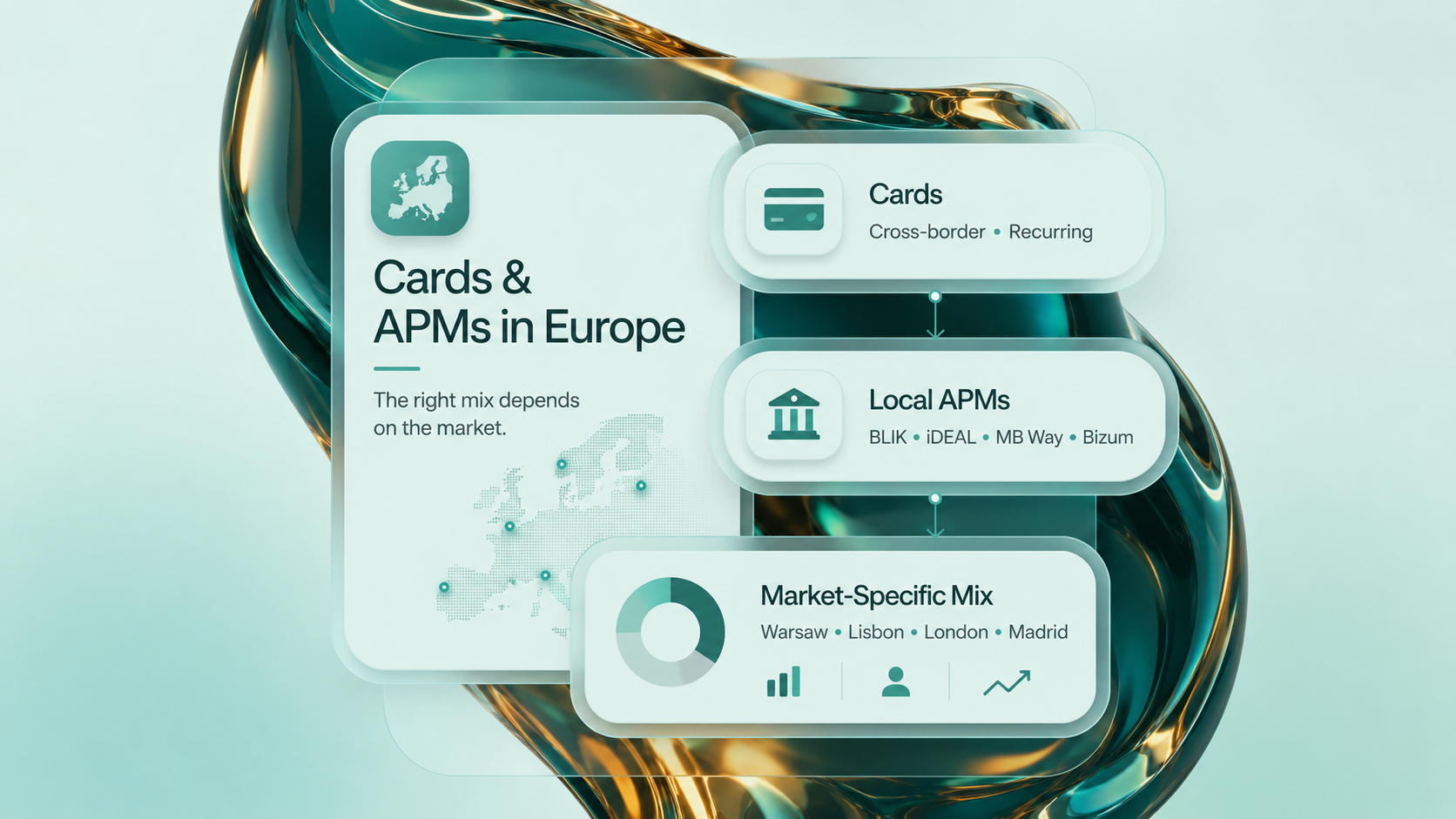
Cards and APMs in Europe: Why the Question Isn't "Which", It's "Where"
A practical look at how European payment preferences fragment across borders, and how merchants build a checkout that converts equally well in Warsaw, Lisbon, London, and Madrid.
There's a comfortable instinct, particularly for merchants used to anglophone markets, to think of card payments as the global default and everything else as a regional curiosity. In Europe, that instinct breaks down quickly.
Cross a border and the way customers actually want to pay can shift completely. A Polish shopper expects to see BLIK at checkout. A Portuguese one looks for MB Way. A Dutch customer reaches for iDEAL almost reflexively. A UK or French buyer might happily use a card, but increasingly through Apple Pay or Google Pay, not by typing it in. None of these customers are doing anything unusual; they're using the payment method that feels native to their market.
For merchants operating across Europe, this is the central operational truth: there is no single right way to take payments. There's a right mix, and that mix is different in every market. Getting it right is one of the highest-leverage things a cross-border business can do for its conversion rates.
This article walks through how cards and alternative payment methods actually fit together across Europe, where each performs best, and how to assemble a payment stack that gives every customer a checkout that feels designed for them.
Cards Are Not Going Anywhere
It's worth saying clearly: card payments remain a foundational layer of European commerce. They're widely accepted, customers in every market understand them, and they're often the only practical way to handle certain situations.
Where cards continue to lead:
- Cross-border commerce, where a single card brand works the same way regardless of which country the merchant or customer is in
- Subscriptions and recurring billing, where stored credentials and well-developed token frameworks make ongoing charging straightforward
- High-value purchases, where consumers value the chargeback and dispute protection that come with card networks
- Markets where the card-payment habit is deeply embedded, the UK, Ireland, France, and Spain among them
The strength of cards is precisely that they don't change much from country to country. The same Visa or Mastercard works in Tallinn and Tenerife. For any merchant whose customer base spans the continent, that consistency is genuinely valuable.
What's changed is that "cards work everywhere" no longer means "cards are preferred everywhere."
What APMs Actually Are
The phrase "alternative payment methods" is broad enough to be slightly unhelpful. In practice, European APMs fall into a few distinct categories, each with its own logic:
- Digital wallets that wrap around existing cards or accounts, Apple Pay, Google Pay, PayPal, and the regional equivalents. These keep the underlying funding source familiar but transform the checkout experience.
- Bank-based instant payment schemes built directly into local banking apps, iDEAL in the Netherlands, BLIK in Poland, Bizum in Spain, Swish in Sweden. The customer authorises the payment from inside the app they already use for their finances.
- Mobile-first local schemes, MB Way in Portugal being a clear example, deeply integrated into how everyday spending happens.
- Account-to-account payments, increasingly enabled by Open Banking, where funds move directly between bank accounts without a card network in the middle.
These methods aren't fringe additions. In several European markets they're now the primary way customers pay online, and a checkout that doesn't offer them isn't merely missing a nice-to-have; it's actively losing sales.
Why APMs Are Growing Faster Than Cards Across Much of Europe
The trend isn't subtle. APM adoption has outpaced card growth across much of the continent for several years running, and in some markets the share of online checkout volume tilts decisively towards local methods.
A few reasons sit behind this:
Localisation feels safer. Paying through a familiar national scheme, particularly one tied directly to a customer's bank, carries a sense of trust that an unfamiliar card form doesn't.
Mobile defaults reward speed. APMs are usually built mobile-first. A customer authorising a payment with a fingerprint inside their banking app finishes the transaction in seconds; the same customer manually entering 16 digits, an expiry, and a CVV on a phone keyboard does not.
Lower friction means fewer drop-offs. Anywhere there's a step, there's potential abandonment. APMs typically collapse multiple steps into one.
Merchant economics often improve. Many APMs come with lower processing costs than cards, faster settlement, and meaningfully lower chargeback exposure, particularly bank-initiated methods, where authorisation comes from the issuer's app rather than from card credentials.
The combination is hard to argue with. Where APMs have won, they've won because they offer customers and merchants something cards simply don't.
How This Looks Market by Market
A short tour of how the picture shifts inside Europe:
United Kingdom. Still a card-led market, but with strong and growing wallet usage. Apple Pay and Google Pay are everywhere, and the line between "card" and "wallet" is increasingly blurred. Open Banking is also gaining ground for higher-value transactions. A UK checkout without wallets in 2026 looks dated.
Poland. BLIK has become the dominant online payment method, with adoption levels that genuinely surprise merchants entering the market for the first time. Cards still work, but ignoring BLIK costs real volume.
Portugal. MB Way is woven into daily life, for shopping, for transferring money, for splitting bills. Portuguese customers expect to see it at checkout in much the same way other markets expect to see PayPal.
Netherlands. iDEAL has been the default for online purchases for so long that its absence from a checkout is conspicuous.
Spain. Card-heavy, but Bizum is climbing fast for both consumer transfers and increasingly for merchant payments.
Germany. A nuanced market that mixes cards, especially for travel and cross-border, wallets, and traditional methods like SEPA Direct Debit and invoice payments. Localisation matters more here than in many neighbouring markets.
Nordics. Often dominated by local schemes, Swish, Vipps, MobilePay, alongside card payments, with high mobile penetration and high expectations of frictionless flow.
The pattern is clear: there's no single European checkout. There are dozens of national checkouts that share some common card rails underneath.
Where iGaming Pulls This Picture Tighter
In regulated, deposit-driven sectors, iGaming and sports betting in particular, the relationship between payment localisation and conversion is even more direct.
Players are sensitive to friction in ways that other verticals aren't, because the moment they want to fund their account is usually tied to something time-bound: a match starting, a promotion expiring, a session about to begin. Any unfamiliar or slow payment step at deposit kills conversion in real time, and pushes the player toward whichever competitor did support their preferred method.
The operators who consistently outperform in European iGaming tend to share a profile:
- Cards covered well, including network tokenisation for repeat deposits
- Wallets, Apple Pay, Google Pay, PayPal where applicable, integrated and well-tuned
- Local methods supported in every regulated market they operate in, BLIK for Poland, MB Way for Portugal, Trustly and Open Banking variants for several others
- Withdrawals supported through the same methods, fast, because deposit-to-withdrawal symmetry is part of how players judge whether a platform is trustworthy
The lesson generalises beyond iGaming, but the iGaming version is the most visible.
Cards vs APMs: Different Tools, Same Job
The "cards versus APMs" framing is misleading because it implies a contest. The reality is closer to a division of labour:
Cards excel at:
- Cross-border purchases where the customer's local payment method isn't relevant to the merchant
- Recurring billing and subscriptions
- Higher-value transactions where dispute infrastructure matters
- Establishing a baseline of acceptance everywhere
APMs excel at:
- Local checkout where customer trust is rooted in domestic banking or wallet brands
- Mobile-first, low-friction transactions
- Markets where APM adoption has reached a point that card-only checkout actively loses business
- Reducing processing costs and chargeback exposure where applicable
A Polish shopper choosing BLIK over typing card details isn't rejecting cards. They're choosing the option that feels native. A subscription customer paying through Apple Pay isn't avoiding cards; their card is inside the wallet. The goal is to support how customers actually want to pay, not to push them toward whatever the merchant happens to have integrated first.
Where Payment Orchestration Earns Its Keep
This is exactly the problem orchestration was built to solve.
Integrating one APM is straightforward. Integrating fifteen, across a dozen markets, with consistent reconciliation, fraud handling, retry logic, and analytics, and keeping all of that maintained as new methods rise and others fade, is a different scale of problem entirely.
A payment orchestration layer lets merchants:
- Add and switch payment methods in each market without rebuilding integrations
- Display the right methods to the right customers, based on geography, device, basket, and risk
- Route intelligently across acquirers for card transactions while local APMs handle their own flows
- Handle retries and fallbacks when a specific method or provider underperforms
- Centralise reporting and reconciliation across cards and APMs in a single view
- Adapt quickly as new methods like growing A2A and Open Banking variants gain market share
Without this layer, each new market entry becomes an integration project. With it, expansion becomes configuration.
Building a European Payment Strategy That Actually Travels
For merchants serious about European growth, a few principles consistently separate the strong stacks from the weak ones:
- Localise the front end seriously. Show the right payment methods, in the right order, in each market. Don't ship a single global checkout and assume customers will adapt.
- Keep the back end consolidated. One orchestration layer, not fifteen direct integrations.
- Plan for change. Payment preferences are still moving. The right answer in 2026 won't be identical to the right answer in 2028.
- Treat checkout UX as a first-class part of conversion work. It often delivers more lift, faster, than equivalent investment in marketing or product.
- Measure at the market level. Aggregated approval rates hide the markets where you're underperforming. Disaggregated views show where the next gain lives.
Done well, this approach turns Europe's fragmentation from a problem into a structural advantage, because the merchants who handle it well leave behind the ones who don't.
The Bottom Line
Cards and APMs aren't competitors. They're complementary layers in a payment strategy that should look different in every European market a merchant operates in. The merchants who win are the ones who match their checkout to local reality rather than asking customers to adapt to a generic global flow.
Europe rewards merchants who pay attention to where customers are paying, not just how much.
At Paylinq, we help merchants build payment infrastructure that takes Europe's fragmentation seriously. Through a single orchestration layer, our clients connect cards, wallets, and the local APMs that drive conversion in each target market, with the routing, risk, and reporting needed to operate them all coherently. If you'd like to map out what a stronger European payment mix would look like for your business, get in touch with our team.
This article is provided for informational and educational purposes only and does not constitute financial, legal, tax, regulatory, or compliance advice. Specific operational, payment, and commercial decisions should be made in consultation with qualified professionals familiar with your jurisdiction and business model. References to specific payment methods, schemes, providers, or markets are illustrative only and do not imply endorsement or guarantee. The authors and publisher accept no liability for actions taken based on this content. Information may become outdated as payment methods, regulations, and consumer preferences evolve.
Simple. Fast. Reliable.
At Paylinq, we deliver a seamless experience with full transparency and effortless operations, so payments just work.
Social Handle
